Dried strawberries

It’s strawberry season in Hampton Roads, and that is major. We love our strawberries around here. Every city in the region that has farms has pick-your-own strawberry fields and it’s a tradition for kids and adults alike to pick strawberries on field trips or on Mother’s Day or Memorial Day weekend when Virginia Beach hosts the Strawberry Festival.

Last week I got an email from a farm saying that they had so many berries in their field that they were going to be offering pick your own berries for $1.25/lb. That is unheard of. You would never ever find berries that cheap in the grocery store. So after sharing it with the Buy Fresh Buy Local Facebook fans, I got in the car and headed to the farm, which thankfully, is only about 10 minutes from my house. Yeah, it was a week day. Yeah, I had a lot of work to do, but sometimes you just have to get up and go pick strawberries. All that work will be there for you when you get back, I promise.

If you’ve never picked strawberries, it’s very easy – they are literally low hanging fruit. When they’re ripe, they get so heavy they just sort of dangle below the leaves and pretty white flowers of their plant. And they pop right off their stems and get tossed right into your strawberry carrying device. The only issue is that if you have a bad back like I do, you may be in a bit of pain the next day (like I was), but that’s why you bring your kids – to do the hard work of bending over and finding the ripest strawberries. When picking, look for deep, red berries. Before plucking them off the plant, lift them up and make sure the underside isn’t white or green (unripe) or that it hasn’t been noshed on by any bugs.

Sometimes you just have to leave your desk and go pick strawberries.

Sometimes you just have to leave your desk and go pick strawberries.

So what to do with 10 lbs of berries once you get them home? Most people I know make strawberry bread, pie, muffins, etc etc. We all know how I feel about baking, so I do one of (or all of) three different thing:

1. Eat them. Duh.

2. Freeze them. Rinse and dry the berries, cut off the caps and then halve each berry and lay in a single layer on a baking sheet. Place the sheet in the freezer for several hours, then put the berries into a freezer ziploc bag. Pull out what you need, when you need it. I freeze pounds and pounds of berries like this every year to use in my smoothies all year long.

3. Dry them. Dried berries are sort of like craisins – tart, but still a little sweet. Perfect in salads, on yogurt or oatmeal, granola, etc. Wash and dry the berries, cut off the caps and halve each berry. Lay in a single layer on a baking sheet and bake at 210 degrees for 3 hours. Let them cool completely, then store in an airtight container in the fridge OR you could freeze these also and just thaw them as you need them. I’m not sure exactly how long they’ll keep in the fridge….you’ve probably got about a week?

Dried Strawberries

Dried Strawberries

Strawberries are pretty amazing little fruits. One cup of berries has only 49 calories and almost 150% of your daily Vitamin C. They also have fiber and protein and good amounts of folates and potassium as well as manganese.

So get out there and pick some today. Or, make your kids do it. Also, can I borrow your kids for an afternoon?

Kefir

A few weeks ago I saw an interesting item come up on my online local food co-op, Coastal Farms. Jen Vaughan, of Vaughan Farms Produce, had posted that she had some extra kefir grains, and was selling them, along with a mason jar and some instructions on what to do with them.  I was intrigued, so I did a little research and it turns out that kefir grains are not actually grains, but rather a symbiotic culture of yeast and bacteria. Yummy! When brewed, they ferment (just like beer or wine) and create an active probiotic culture (just like yogurt). Kefir is probably most well known as a yogurt type of product or kefir milk, but it turns out you can also brew kefir into “kefir water” which is sort of a sparkling-like fermented beverage. The fizziness of it comes from the fermentation and can be adjusted based on how much air is allowed in during the process. The whole process and product is very similar to Kombucha, which is probably a little more well recognized.

Kefir grains and my first kefir water batch

Kefir grains and my first kefir water batch

I ordered my first batch and got to brewing! Jen had a few great suggestions for recipes to give the water flavor. Plain kefir water isn’t exactly delicious, so it’s recommended that you mix it with flavorings, which can range from green tea to juice to vanilla extract, depending on how you want it to taste. For my first batch I did a green tea flavoring, then I followed that with a cream soda style flavor and now I am on to a citrusy grapefruit juice. The process is simple:

1. Dissolve 1/4 cup of raw, brown sugar (I’m using raw demerara sugar) in 1 quart of distilled water (or spring or mineral water, according to the interwebs) in a container with a lid (I used the 1 quart mason jar Jen provided). Make sure the water is room temp and not hot – that will kill the grains. Drop in a raisin or two (they will be your ‘tell’) and a lemon slice if you have one (helps with the Ph). Put in three tablespoons of kefir grains. Put the container with the lid just set on top – not screwed on, in a warm place out of direct sunlight. For me, this was on top of my fridge.

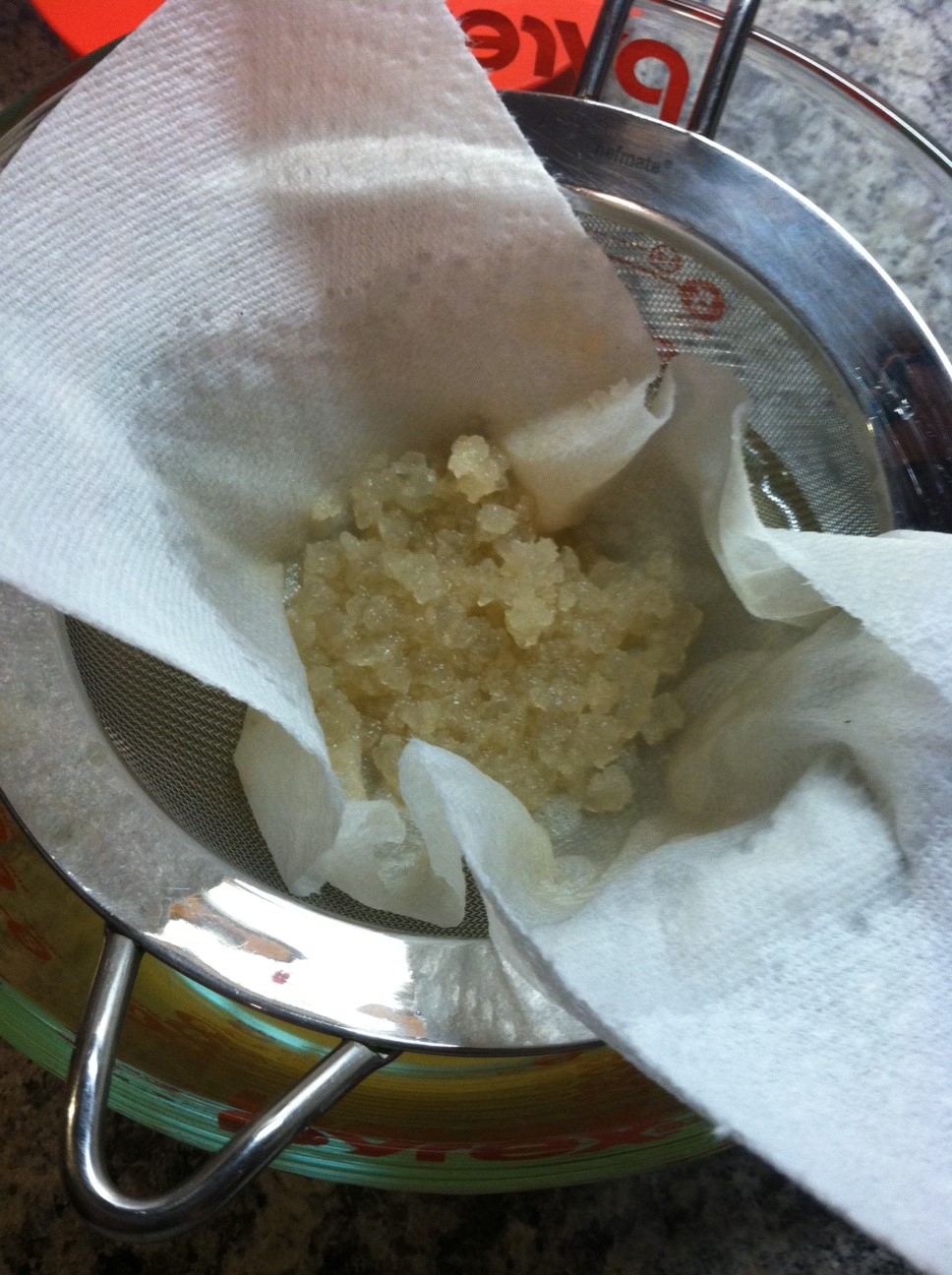
2. When the raisins have floated to the top of the water, usually 2-3 days, the water is done “brewing.” Remove the lemon slice and raisins, then strain the water through a fine sieve. Here’s the trick – kefir doesn’t like metal – you have to use glass or plastic or in my case, I just put a paper towel on my metal sieve and strain it that way. Cheesecloth would also work, if I could find it anywhere, ever. Put your kefir grains back into your mason jar or container and start again with 1 quart of water and 1/4 cup of sugar, raisins, lemon, etc – the grains can pretty much be brewed indefinitely.

I strain the kefir through a paper towel lined sieve since metal can kill the grains

I strain the kefir through a paper towel lined sieve since metal can kill the grains


3. Take your strained kefir water and add your preferred flavorings. Here is what I’ve tried:

  • 1 part very strongly brewed green tea to 1 part kefir water.
  • 1 tbs vanilla extract and an extra 1/4 cup raw sugar (creates a cream soda style water)
  • 1 part grapefruit juice to 1 part kefir water, one sliced lemon, one sliced lime

Once you’ve added your flavors, put it through a second fermentation – so put it back in another container with a lid just resting on top in a warm place out of sunlight for about 2 more days. At this point, if you’ve added things (like lemon and lime slices) strain it again and then bottle it up and put it in the fridge. The water will last as long as whatever you’ve brewed it with would. So however long you’d leave a pitcher of brewed tea in your fridge is how long you can leave the kefir water brew in there and it will be fine. Keep repeating the process with your other fermenting batch and you can have indefinite kefir water!

my first taste!

my first taste!

There are innumerable ways to prepare and brew your kefir water and also tons of sites online where you can purchase the grains. I found this site particularly helpful: http://www.culturesforhealth.com/water-kefir-frequently-asked-questions-faq

I have noticed that since I’ve been drinking the water every day, my stomach issues have decreased some. It’s like I’m drinking my probiotic pills (which I also continue to take) and it certainly can’t hurt to get as much good bacteria going as possible. If you suffer from any kind of intestinal issues, or even if you don’t – I would really recommend giving this a try. The fizziness is nice without being too much (I hate soda and carbonated beverages, but this is the perfect amount of fizz for me), and the flexibility of flavorings is really nice. And because the grains basically feed on the sugar in the brewing process, the overall sugar content of kefir water is much, much lower than you would imagine based on how much you put in at the beginning. According to CulturesforHealth.com “approximately 20% of the sugar you start with will remain following a 48- hour culturing process and almost all that sugar will have been converted to fructose from its original glucose-fructose state.  Therefore if you use our recommend ratio of 1/4 cup sugar to 1 quart water, the finished kefir will contain approximately 1.4% fructose.” That’s pretty low – much lower than fruit juice, juice cocktails and certainly less than soda.

So give something different a try! Love the good bacteria!

strained kefir grains

strained kefir grains

Pantry Raid IV: better bulgur

Bulgur sounds gross, and I get that. But it’s really not. Bulgur is parboiled cracked wheat berries. It’s a super whole grain with a wonderful nutty taste. It also has a great texture that I can only describe as “toothsome.” It isn’t hard, but even after being soaked, it has tooth –  like very good al dente pasta. Just one cup of bulgur has over 25 grams of fiber and over 17 grams of protein. And incidentally, I had a huge bag of it in my cabinet that I needed to start working on getting rid of.

Bulgar, like quinoa, is a great base for salads. This bugar salad recipe came from Everyday Food, and it’s really light and delicious and keeps well. Make it at the beginning of the week, measure it out into individual containers and then grab them for a healthy lunch on the go. This recipe makes a lot – like most grains, just one cup, once cooked, makes a huge amount of food and because it is high in fiber and protein, you don’t need to eat much to get full. I made this salad for dinner with a yummy marinated salmon and still had enough left over for lunch several days that week. This salad also incorporates chick peas (or Garbanzo beans – whichever name you prefer). Chick peas are also full of protein, so you really can’t go wrong here. Leave out the feta for a (still delicious) Vegan side dish.

Bulgur and Chick Pea Salad

bulgar with salmon close

Ingredients

  • 1 cup bulgur
  • 2 cups boiling water
  • 1 can (15.5 ounces) chickpeas
  • 1 tablespoon lemon zest and 2 tablespoons juice
  • 3 tablespoons extra-virgin olive oil
  • 1/4 cup roughly chopped fresh dill
  • 1/2 cup crumbled feta (2 ounces)
  • Salt and pepper

Directions

  1. In a large bowl, combine bulgur with boiling water. Cover and let stand 20 minutes; drain and return to bowl. Rinse and drain chickpeas, then add to bowl with lemon zest and juice, olive oil, dill, and feta; season with salt and pepper.

For the salmon, I combined a little olive oil, a dash of white wine vinegar, the juice of half of a lemon, some dill, salt and pepper and put the salmon into some tin foil, made a pouch, poured the marinade over the salmon, wrapped it up really good and baked at 375 for about 15 minutes. It was perfect together and it would be a crime to eat this meal without a glass of good Chardonnay. So don’t let the name throw you off, replace that pasta side dish with a healthier bulgur alternative.

If you eat this without a glass of Chardonnay, you are committing a crime against food.

If you eat this without a glass of Chardonnay, you are committing a crime against food.

The possibilities here are endless – Greek bulgar salad with grilled chicken, feta, cucumbers, tomatoes and kalamata olives; bulgar and lentil salad with grapefruit vinaigrette, breakfast bulgar with maple syrup and baked apples . . . OK, I’m starting to sound like a bulgur growing Bubba from Forrest Gump. You get the picture.

Pantry Raid – Part II

One of the things that had created an abundance of random odds and ends in my cabinets was the detox diet I did back in the late summer/early fall. My diet was extremely restricted and so I purchased a lot of things that were on the “OK” list that I would otherwise not eat like raw nuts, strange beans and wild rice. I had two boxes of wild rice and a can of Aduki beans that I just had no idea what to do with, but I found a recipe for wild rice and aduki bean stuffed acorn squash on Pinterest. Seriously, if you look long and hard enough, you will find the exact recipe you need. The recipe was from a vegan site, so I made a few changes to it to fit with what I had on hand, and it turned out pretty good. With a side of raw kale salad marinated in a home-made vinaigrette, this little vegetarian meal packed a serious healthy punch. Plus, it’s so protein packed, I could only eat half of it.

Wild Rice and Aduki Bean Stuffed Acorn Squash

Wild rice stuffed acorn squash

Ingredients:

  • 2 acorn squash, sliced lengthwise, seeds scooped out
  • Olive Oil
  • Wild Rice
  • 1 cup chopped onion
  • 1 can Aduki beans, rinsed and drained
  • 1 tbs Soy Sauce
  • 2 tbs honey (or Agave)
  • Pepper and Salt to taste
  • Cranberry sauce (canned or homemade)

Method:

  1. Rub the acorn squash down, inside and out, with olive oil, season with salt and pepper. Place an a baking sheet and cover with foil. Bake at 375 degrees for an hour, or until tender. 
  2. Meanwhile, cook the wild rice according to its directions, enough to make two cups.
  3. Heat the oil over medium heat in a large skillet. Add onions and sautee until soft. Add in Aduki beans, soy sauce, honey and season with salt and pepper. Combine and keep warm over medium low heat.
  4. Remove squash from oven when done, and scoop out the squash, leaving about 1/2” of squash in the shell. Chop the squash and mix it into the bean mixture and add the rice. Combine well over low heat until warmed through.
  5. Load each squash half with the mixture and top with cranberry sauce. Serve immediately.


I still have one box of wild rice left that I’m not sure what to do with, but at least those beans aren’t staring at me anymore.

What random item do you have in your cabinet that you’re just not sure what to do with?

Foodie Friday Freestyle

We usually stay in on Friday nights. We are exciting like that. But one of my favorite things to do on Friday nights is “freestyle” a few small plates with things we have around the house. It’s like iron chef or chopped or something. You can only use things you have in your basket….three to five courses….except without someone berating the hell out of whatever you come up with. So, if it pleases the judge panel….

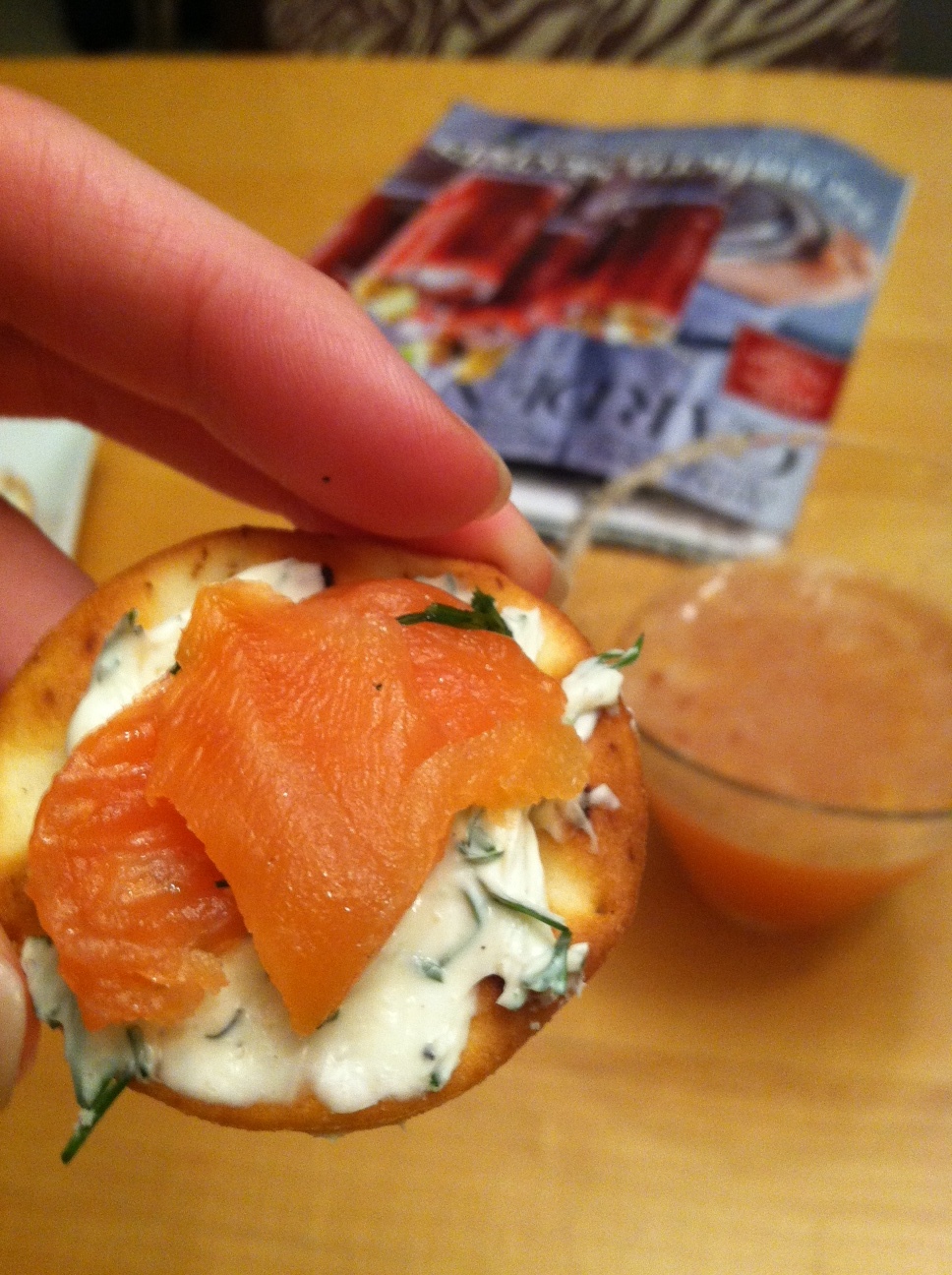
1. Smoked salmon with fresh dilled cream cheese on pita crackers.

20130215-210005.jpg

2. Baked turnip “chips”

20130215-210146.jpg

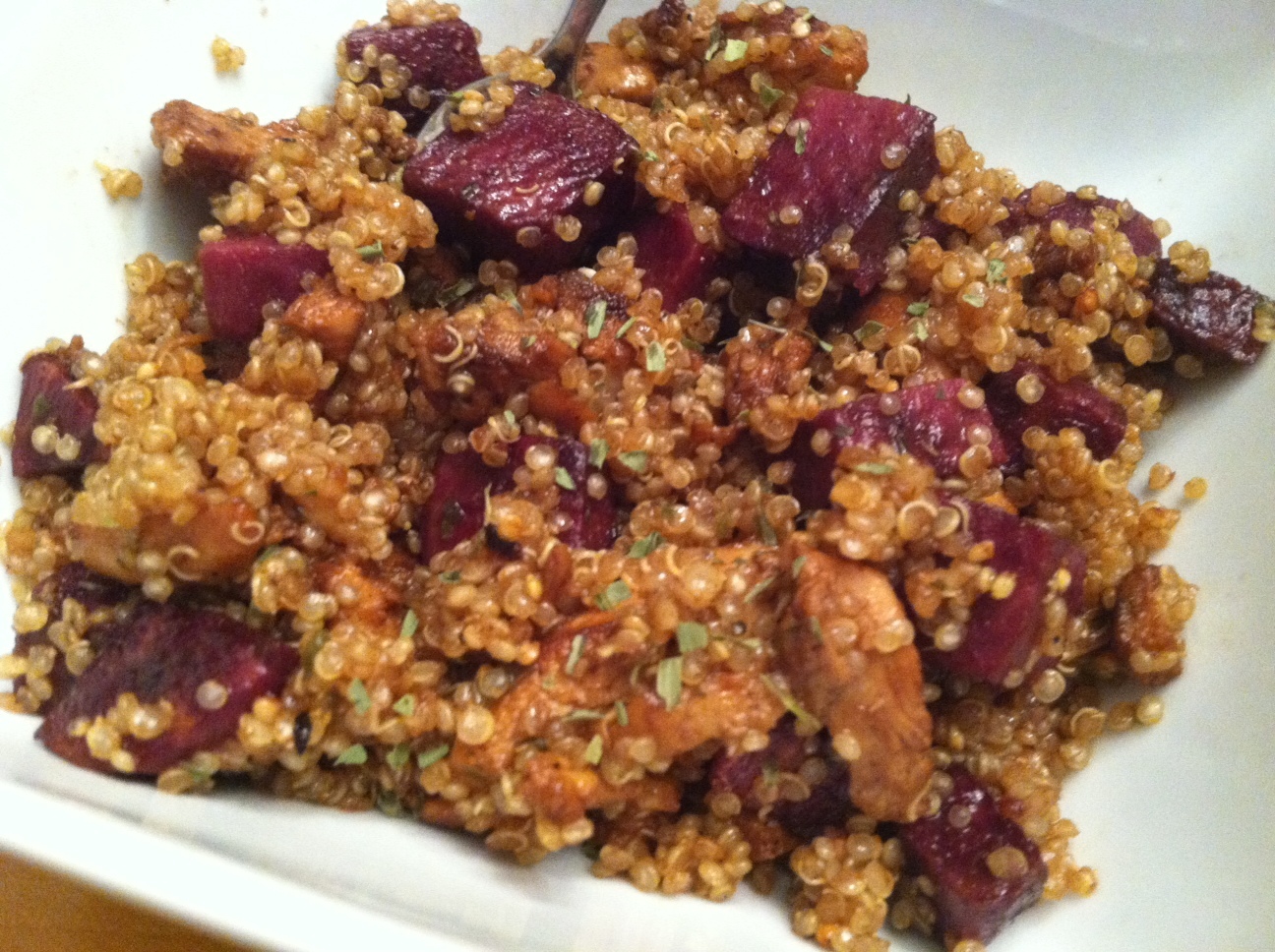
3. Balsamic glazed chicken thighs with quinoa and roasted Okinawa purple sweet potatoes.

20130215-210317.jpg

For the record, always cook with chicken thighs. Chicken breasts dry out more easily, are inconsistent in thickness (which makes them hard to cook) and don’t have as much flavor as dark meat. You know when you have delicious Mongolian BBQ and you think “I can never make chicken taste like this at home”? That’s because it’s chicken thighs. Oh, they are also usually cheaper.

Usually my Friday freestyle foods aren’t recipes. I just make it up as I go along. I likely won’t make another dish exactly like any of them again since they are usually about an unusual combination of things I have at that moment. But it’s exciting and different. Unlike our average Friday nights.

Eggcellent

20130211-154304.jpg

Hard boiled eggs are my favorite high-protein snack. I recently learned that steaming farm fresh eggs for 17 minutes is actually a better way to prepare them. Fresh eggs are hard to peel once they’ve been boiled. Hard boiled (or steamed) eggs can be kept, in their shell, in the fridge, for up to a week. So make a dozen at the beginning of the week for protein rich, ready to eat snacks. Go to localharvest.org to find local eggs near you.

what is your favorite healthy snack?

the other green

I was reading a story in Edible Piedmont this morning about a kale recipe, which could also be made with collards. The author made this substitution because she said she knew how popular collards are in eastern North Carolina, so much so that the region has been referred to as “The Collard Belt.” I’ll take it. But I’ll also take kale. Any day of the week. I think it’s actually a bit more palatable to the general population than collards and is usually cooked in more various ways.

I know it’s sort of cliche to have a food blog and regale the benefits of kale. Everyone gets it, I know. Kale is great, it’s good for you, it’s a super food, put it in your smoothies, bake it into cookies, blah blah blah. But seriously. It’s great. So great that I highlighted one of my favorite kale recipes in my January column in Tidewater WomenThe column this month is about resolving to “Live Locally” and what that means, how it benefits not only you personally, but your community as a whole. I also put it in there to remind people that local food isn’t in hibernation during the winter months. It’s readily available, if you’re willing to look for it, and to try something you might not otherwise try (ie – kale. or chard. or other things that are green and look like dinosaur food.) Not wanting to be a hypocrite, I went out yesterday, tracked down some kale and made this recipe, which I share with you below. It really is a great recipe, especially for the new year, if (like me) you are trying to drop a few “party pounds” from the holidays….this meal is so packed with protein that after only half a bowl you’ll feel completely full. It’s also so lo-cal and healthy that even if you down all four servings in one night, there’s really nothing to feel guilty about. Except for the amount of flatulence you will inevitably plague your family with if you decide to do that. ANYWAYS.

I found this kale at a little roadside stand out in front of somebody’s house. These are my favorite places to shop because it’s fresh, you’re helping support someone’s backyard gardening habit, and the produce is usually dirt cheap. I got a pound of kale and a dozen fresh, free-range eggs for $4. I could also have scored 4 lbs of sweet potatoes for a dollar if I’d liked. Keep an eye out for these stands in your neighborhood or town. And don’t feel shy or weird about driving up to them. The people who set them out are usually so nice and happy to have a customer. The chicken came from a Crock Pot Chicken I’d made earlier in the week. This was one of three meals I got out of one five pound chicken. The only change I make in this recipe is that I use dried lentils that I cook and season myself. I’ve never been able to find canned lentils in my grocery stores, but if your store has them – more power to you. If you go this route, use half the bag (1/2 lb) – not two whole cups of dried beans, as they will expand as they cook. 1/2 lb will give you just over two cups once cooked.

Shredded Chicken with Kale and Lentils

kale cooking

CAST IRON LOVE.

Ingredients:

  • 2 tablespoons extra-virgin olive oil
  • 1 small onion, finely chopped
  • 1 teaspoon fresh thyme leaves
  • Coarse salt and ground pepper
  • 2 bunches kale, tough stems removed, torn into bite-size pieces
  • 2 cups lentils (from a 15.5-ounce can), drained and rinsed
  • 2 cups shredded cooked skinless chicken breasts
  • Lemon wedges, for serving

Method:

  1. In a large skillet, heat 1 tablespoon oil over medium heat. Add onion and thyme; season with salt and pepper. Cook, stirring occasionally, until onion is softened, about 5 minutes.
  2. Add kale and cook, stirring occasionally, until kale is wilted and tender, 4 to 6 minutes. Transfer to a medium bowl.
  3. Add 1 tablespoon oil and lentils to skillet; season with salt and pepper. Cook, stirring, until warmed through, about 20 seconds. Transfer to bowl with kale, toss to combine, and divide among four bowls. Top with chicken and squeeze lemon over top. Serves 4.
Shredded chicken with kale and lentils

Shredded chicken with kale and lentils

I agree with what you’re thinking – this looks like a recipe you see in those magazines all about getting fit with advertisements for muscle milk supplements. But honestly, it doesn’t taste like that. It tastes yummy AND healthy, which is possible, I promise. Jeremy even got seconds. Flatulence be damned!


Pinterest Perfection

I’m sure many, if not most, of you have heard of Pinterest. I first heard about this little site where you could “curate” your own visual boards over two years ago when the site was still in Beta testing. I did some quick researchpinterest-logo on the trusty interwebs and lo and behold, I was able to track down the Pinterest CEO to his person twitter page, where I began a barrage of direct messages begging for a beta tester invite. I got it. His name is Ben, by the way, and he’s super nice. I was one of the first few thousand people to use the site, and use it I did. I currently have over 30 boards, 981 pins and 125 followers. When Pinterest first started it was much more of an art and design crowd. The cool kids who were developing the site had no doubt invited their other cool kid friends who I’m sure were all interior designers, graphic artists, and web developers in San Francisco (that’s where the company is based, not the valley, which is why the site and its people are so cool) to give it a whirl. As Beta opened up to user invites, and the site became a real, live thing, it became much, much, much more crafty, crock potty and crap to do with your kidsy. But you know what? I still love it. Despite the fact that I have to sift through hundreds of pins of maternity photo sessions to get to the thing I’m looking for, despite the fact that when I search the food category I have to ignore a million recipes that suggest throwing four different kinds of canned Campbell’s crap into your slow cooker and feeding it to your family of 10 for less than .30  cents a serving, I still think it is an awesome, amazing thing. And every once in awhile, you run across some real gems.

On Wednesday of this past week, I made THREE recipes for one meal that I found on Pinterest: A Roasted Garlic salad dressing, a rosemary and Parmesan overnight bread, and an Italian style beef and butternut squash stew. They were all the kind of things that keep me obsessed with the site. Diamonds in the rough.

The Roasted Garlic Vinaigrette is a MUST try to anyone who loves garlic on the level that I do. Two heads of garlic go into this dressing. And while you do have to roast the garlic for a good half hour, the dressing itself is really easy to make, and you probably have most of the ingredients on hand. I’m currently obsessed with making my own salad dressings and have tried several I’ve found on Pinterest, but this one is my favorite.

From Fat Girl Trapped in a Skinny Body:

Roasted Garlic Vinaigrette
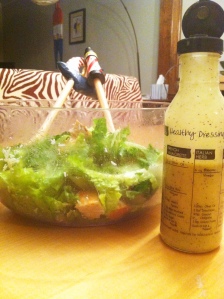
pinterest meal salad dressing

Ingredients:

  • 2 heads of garlic, roasted and peeled
  • 1/2 cup extra virgin olive oil
  • 1/4 cup apple cider vinegar
  • 2 tbsp lemon juice
  • 1/2 tsp kosher salt
  • 1 tsp black pepper
  • 1 tbsp honey

Method:

  1. Cut the pointy top off of the garlic. Brush them with olive oil and roast them in a pan in the oven at 400 degrees for about 25 minutes, until it is starting to turn golden brown and soft. Remove from the oven, allow to cool. Once the garlic is cool, peel the skin off. Discard the skins, save the garlic. *Skin peels off really easily after they are roasted.
  2. Add all the ingredients to the food processor and process until smooth. Refrigerate until ready to serve.*If some of the skin get processed with the rest of the dressing, no big deal, it won’t change the flavor.

The salad dressing can be vegan if you sub the honey for agave. And it is dairy free, with no substitutions!

This dressing is tangy, but has that deep, rich caramelized taste from the roasted garlic. It’s a vinaigrette, but it’s creamy because of the garlic being processed right into it. Keep this for a week or so in your fridge in a covered container.

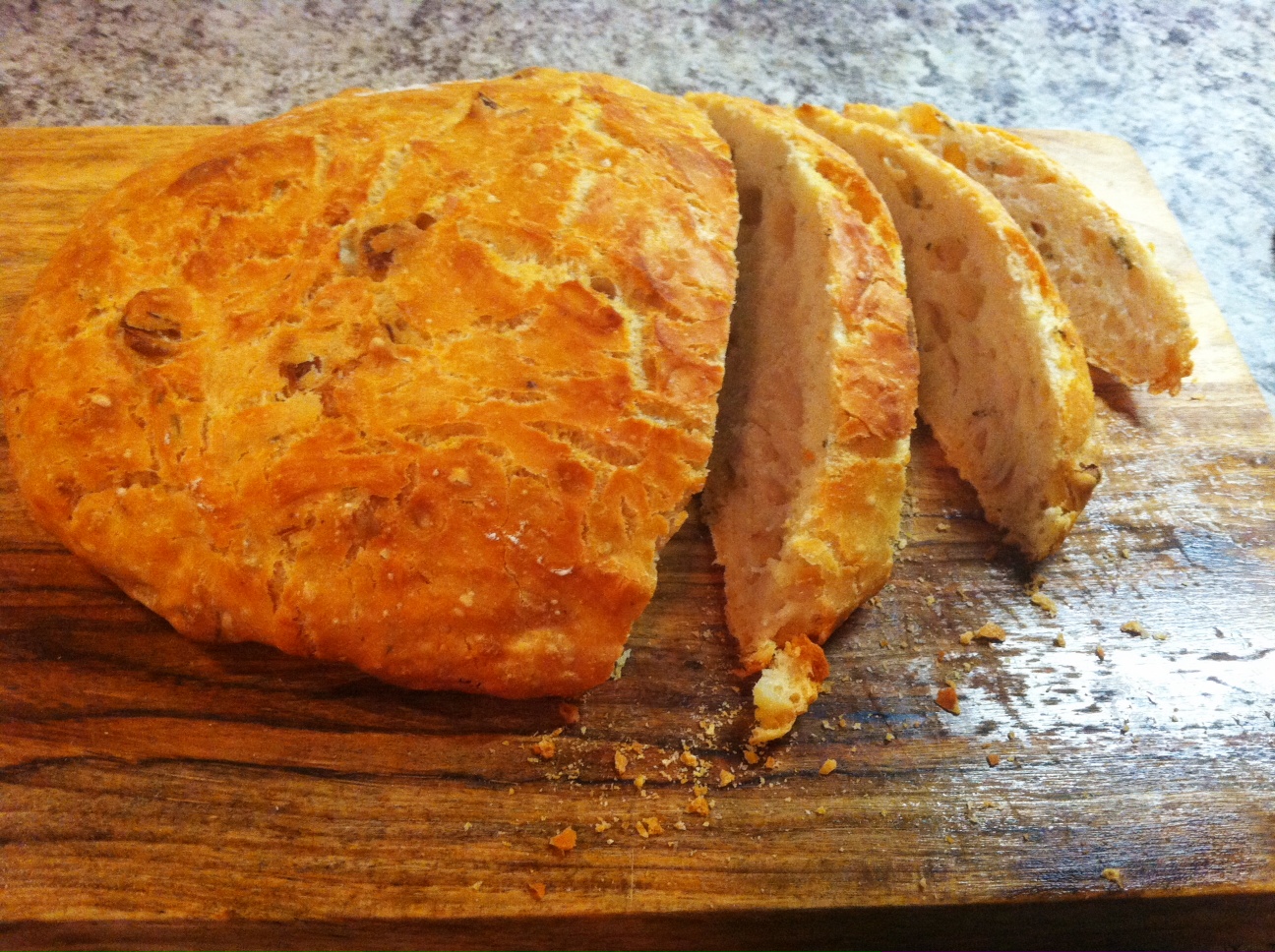
The bread recipe I comes from Simply So Good. I used her basic bread recipe, and put in my own additions. This bread is baked in your cast-iron enameled Dutch Oven (you have one of those, right??). I have a big, blue Le Creuset that is the Pride and Joy of my kitchen. Jeremy gave it to me for Christmas a few years ago. They are usually in the $300-$400 range, but sometimes you can score them at T.J. Maxx for half the price, which I believe is what he did (smartly). Other cast-iron enameled pots are fine for this recipe also, but when you have a Le Creuset, you tend to brag about it. Here is a view down on mine to give you an idea of the size of the vessel you might want to use:

I ❤ Le Creuset

OK, enough about my awesome piece of iron. Here’s the recipe.

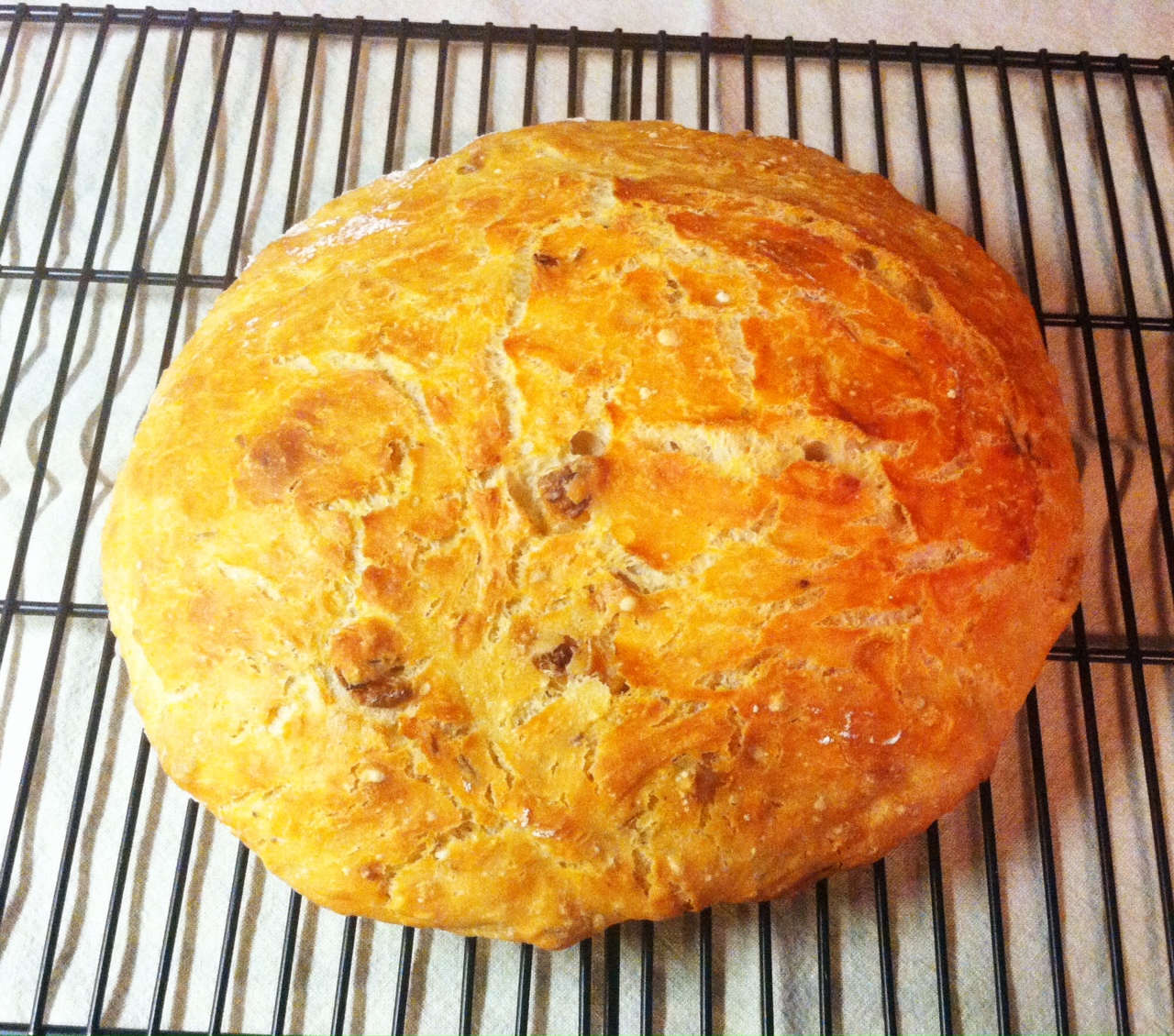
Crusty Bread
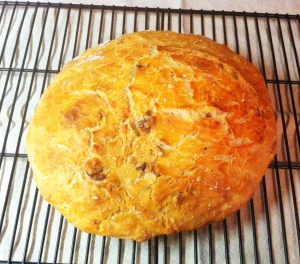
Crusty Overnight Bread

Crusty Overnight Bread

Ingredients:

  • 3 cups unbleached all purpose flour
  • 1 3/4 teaspoons salt
  • 1/2 teaspoon yeast
  • 1 1/2 cups water

 Method:

  1. In a large mixing bowl, whisk together flour, salt and yeast.  Add water and mix until a shaggy mixture forms.  Cover bowl with plastic wrap and set aside for 12 – 18 hours.  Overnight works great.
  2. Heat oven to 450 degrees.  When the oven has reached 450 degrees place a cast iron pot with a lid in the oven and heat the pot for 30 minutes.  Meanwhile, pour dough onto a heavily floured surface and shape into a ball.  Cover with plastic wrap and let set while the pot is heating.
  3. Remove hot pot from the oven and drop in the dough.  Cover and return to oven for 30 minutes.  After 30 minutes remove the lid and bake an additional 15 minutes.  Remove bread from oven and place on a cooling rack to cool.

To this recipe, I added 1/4 cup of fresh grated Parmesan Cheese, 1/8 cup of fresh rosemary (from my garden), and several cloves of smashed and roughly chopped garlic. I added that in to the dough at the very beginning and then proceeded as normal through the recipe.
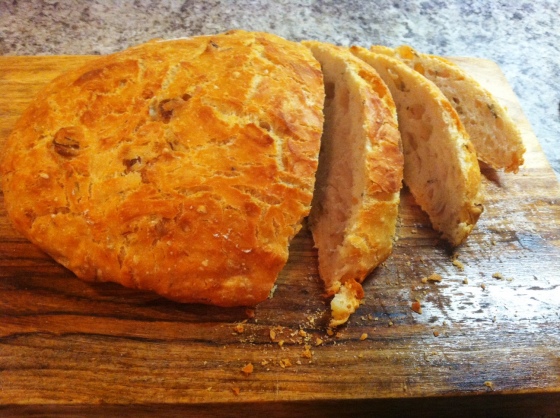
pinterest meal bread cut

This thing turned out beautiful. There is nothing quite like making your own bread from scratch and this is really a pretty easy way to do it.

Finally, the main course – Beef and Butternut Squash Stew from Closet Cooking. I’ll be honest and say there are a few things wrong with the way this original recipe is written, so the recipe below has a few very minor changes from myself, just to make things more clear.

Italian Style Beef and Butternut Squash Stew

pinterest meal stew 2


Ingredients:

  • 2 ounces pancetta (diced)
  • 1 pound beef (cut into 1 inch cubes) (My Note: he doesn’t specify what kind of beef to use here. My suggestion is to get a sirloin roast, if you can find one – that’s what I used. Otherwise a small round roast is fine or chuck if nothing else is available)
  • 1 onion (chopped)
  • 3 cloves garlic (chopped)
  • 1/2 teaspoon red pepper flakes (optional, to taste)
  • 1 tablespoon rosemary (chopped)
  • 1 tablespoon thyme (chopped)
  • 1 cup Italian red wine (My Note: I used a Zinfandel. It doesn’t have to be Italian, don’t stress out, just use a decent red wine that’s not sweet)
  • 3 cups beef broth
  • 1 splash balsamic vinegar
  • 1/4 cup sundried tomatoes (chopped)
  • 1 (28 ounce) can diced tomatoes (My Note: He doesn’t specify drained vs. undrained. Because he does not, I put them in without draining them. It gave my stew a more “soupy” consistency, which I was OK with. If you want this to be more like a traditional stew, then drain the tomatoes before adding).
  • * parmigiano reggiano rind (optional)
  • 1 teaspoon oregano
  • salt and pepper to taste
  • 1 pound butternut squash (peeled, seeded and cut into 1 inch cubes)
  • parsley (chopped) (My Note: optional for garnish. I used a bit of grated Parmesan instead).

Method:

  1. Cook the pancetta in a large pan on medium heat. (My Note: or Dutch Oven. Again, with my Creuset)
  2. Add the beef and brown on all sides in the grease from the pancetta and set aside. (My Note: I coated the beef cubes in flour first. I’ve always done this when searing beef that is basically going to be braised later. It also helps to thicken the sauce a bit, but it’s up to you).
  3. Add the onion and saute in the pancetta grease until tender, about 5-7 minutes.
  4. Add the garlic, red pepper flakes, rosemary and thyme and saute until fragrant, about a minute.
  5. Add the wine and deglaze the pan. (My Note: deglazing means you add a liquid to absorb the browned bits from the pancetta, beef and aromatics. When you add the wine to the hot pan, it will steam up. Take a wooden spoon and use that moment to scrape up all the bits in the bottom of the pan, stirring them into the liquid to create a flavorful base).
  6. Add the beef, broth, balsamic vinegar, sun-dried tomatoes, diced tomatoes, parmigiano reggiano rind, oregano, salt and pepper and bring to a boil.
  7. Reduce the heat, cover and simmer until the beef is nice and tender, about 1-2 hours.
  8. Add the squash and simmer until it is tender, about 15-20 minutes. (My Note: more like half an hour, at best).

This stew was filling, hearty and really quite healthy. Serve it with a glass of the same wine you used in the soup – superb! Always cook with wine that is good enough to drink. When you cook with wine, you are cooking off the alcohol, but intensifying the flavor. If you intensify a crappy wine, you will just get really intense crap. No Bueno.
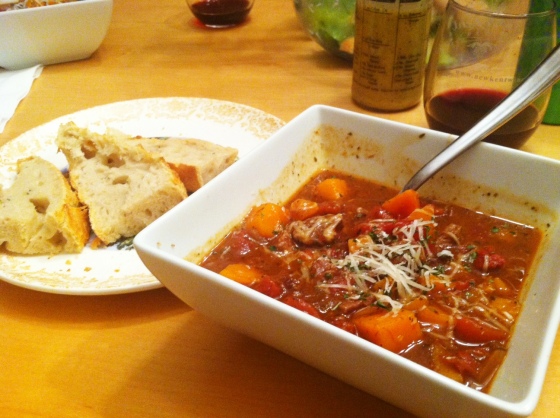
Pinterest Perfection

Pinterest Perfection

The dressing, served over a bed of Organic romaine lettuce, the garlic, rosemary and Parmesan bread and this stew altogether? Perfection. Pinterest Perfection.


The root of it all

I just gave myself an award for the most clever blog title ever.

i ❤ beets

It is a shame, I realized, that this blog’s namesake has never really been examined thoroughly. I think in my very first blog post I may have posted a picture of a beet dish I had done, but I’ve never really delved into this amazing little root that inspired me to make this blog. There are a few reasons that beets are the thing I happen to heart. They are available locally, they are available at several times throughout the year and many people don’t like them. Why is that a reason to make beets the central theme of a blog? Because I think I can change people’s minds. I think a lot of foods out there that deserve our attention but suffer general distaste have just been presented wrong all this time. Like the poor Brussels sprout, which I will post about later . . .

Take, for instance, my husband who insisted he hated beets. So I asked in what format he had experienced beets in the past and he said either canned, pickled or boiled to death. Well, no wonder. He also hated Brussels sprouts for similar reasons. But there is a simple answer to both of these food fears and it is this: roasting. Roasting, which uses dry, indirect and diffused heat (such as an oven) increases flavor by caramelization and the Maillard browning reaction. Essentially, roasting enhances the sugars in foods through a process called pyrolysis, which I will not get into, because I barely passed chemistry. But here is what I do know: it makes food delicious. Especially foods like beets, which already have a high natural sugar content, just waiting to be released.

Beets are also so nutritious. Here are some facts from Nutrition and You about beets:

  • Beets are a rich source of phytochemical compound, glycine betaine. Betaine has the  property of lowering homocysteine levels within the blood. Homocysteine, a highly toxic metabolite, promotes platelet clot as well as atherosclerotic-plaque formation, which, otherwise, can be harmful to blood vessels. High levels of homocysteine in the blood result in the development of coronary heart disease (CHD), stroke and peripheral vascular diseases.
  • They are also a rich source of B-complex vitamins such as niacin (B-3), pantothenic acid (B-5), pyridoxine (B-6) and minerals such as iron, manganese, copper, and magnesium.
  • The root has very good levels of potassium. 100 g fresh root has 325 mg of potassium or 7% of daily requirements. Potassium lowers heart rate and regulates metabolism inside the cells by countering detrimental effects of sodium.

And while us die-hard beet fans can eat a beet canned, pickled, boiled, grilled or anything else, for those skeptics out here, this is my GO-TO beet recipe. I’m not sure where it originated from…I think a friend may have suggested this method and I’ve just sort of made it my own over time, I’m not really sure. My hope is that you will love it enough to make it your own, adding, subtracting and substituting to your liking.

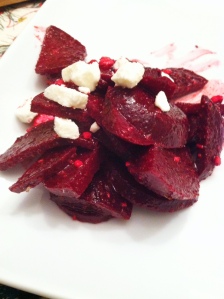
Roasted Beet Salad with Vinaigrette

Ingredients: Beets in vinaigrette

  • One bunch beets (as seen above)
  • 3 tbs olive oil
  • 1 tbs vinegar of your choice (balsamiq, red wine, champagne, whatever you like)
  • 1 shallot, finely diced
  • 1 tbs dried herbs (Italian, Herbs de Provence, fresh or powdered garlic or whatever else you’d like)
  • Salt and Pepper to taste
  • 1 cup crumbled feta cheese

Method:

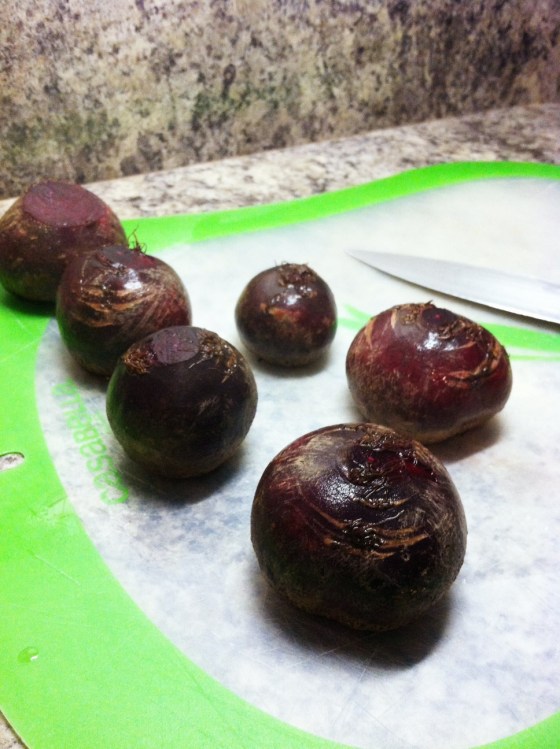
  1. Pre-heat oven to 375 Fahrenheit. Cut the beets off their stems and trim off the tops and the “tails” of each beet. Clean each beet so they are free of dirt. Wrap each beet in individually in tin foil and place in the pre-heated oven, directly on the center rack. Roast for 30-40 minutes, or until each beet is easily pierced with a knife. 
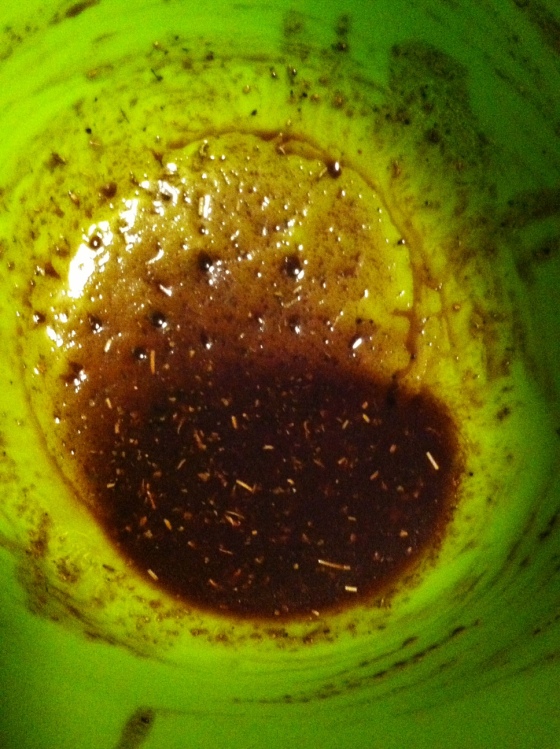
  2. While the beets are roasting, create your vinaigrette. The most important thing to remember here is the a vinaigrette dressing always 3 parts oil to 1 part vinegar. You can use any combination or any measurement (tsp, tbs, cup, etc), as long as you keep that ratio the same. Pour your oil, vinegar, shallots, herbs, salt and pepper into a medium sized bowl and whisk until they are emulsified. Set aside until beets have finished roasting.
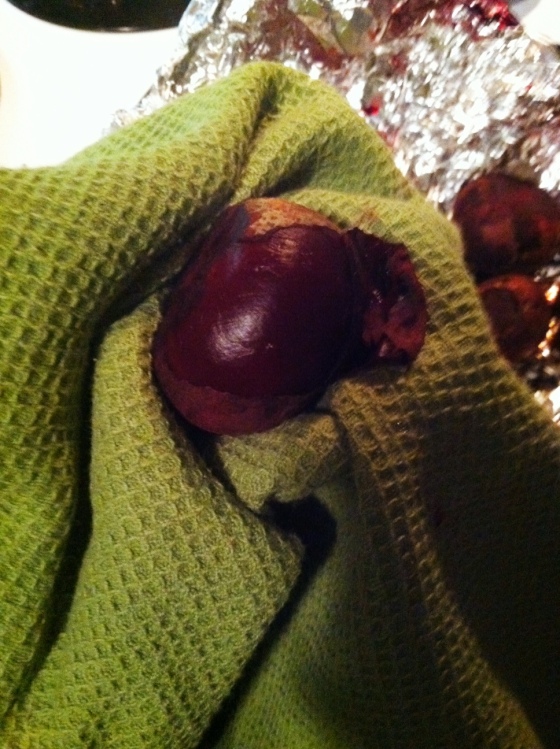
  3. When beets are easily pierced with a knife, unwrap from tinfoil and allow to cool. Take an old dishtowel and peel the beet’s skin off with the towel – if it’s roasted to completion, the skin should slide off easily. Do this with each beet.
  4. Cut each beet in half or in quarters, if large, and cut into thin slices. Re-whisk your vinaigrette so it is well blended, then add your beets to the bowl and toss to coat. Plate, then top each serving with a spoonful of feta cheese.
Trim and wash beets

Trim and wash beets

A well emulsified vinaigrette

A well emulsified vinaigrette

Beets

After roasting, remove skin with a dish towel

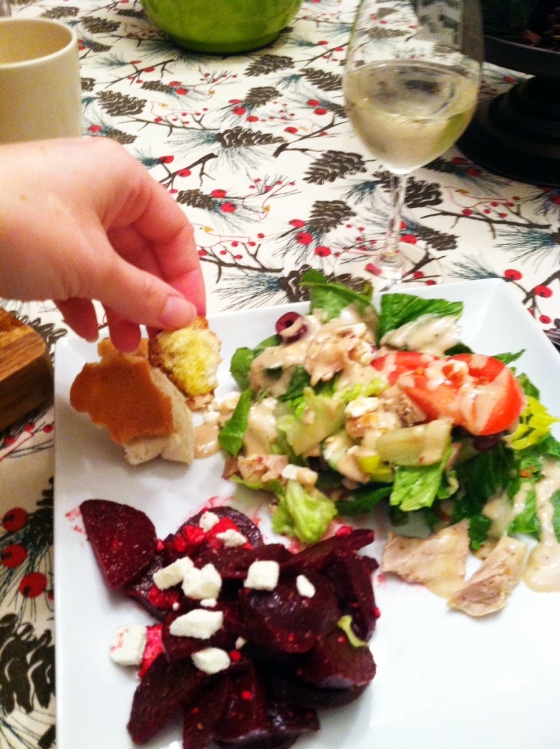
Served with Greek salad, crusty French bread a Pinot Grigio.

Served with Greek salad, crusty French bread a Pinot Grigio.

If you don’t like beets like this, then I grant you the right to dislike beets. But before you file them away in things that are gross and that you refuse to eat, please try this recipe. Please. Give beets a chance.

Note: these beets were purchased from Westside Produce and Provisions where they were sourced from New Earth Farms in the Pungo area of Virginia Beach, where they use sustainable and organic growing methods. 

Detox Lessons Learned

I am back to a pseudo-regular diet and the good news is that wine does not seem to affect me at all. (Huzzah! And just in time for Virginia Wine Month!) However, beer is probably off the menu for good. And anything that combines dairy, cheese and wheat, although separately, they seem to be OK.

So here are some lessons I’ve learned and things I’ll continue to practice now that my detox is done:

  • You don’t need nearly as much food as you think you do. Hunger is a state of mind, not of body.
  • Fast (with juice and smoothies) one day a month, or once a week if you can. This gives your digestive system a break, particularly after a long weekend or the holidays, etc.
  • I do not NEED coffee every morning. Substitute herbal tea a few times a week and only have one cup of coffee on the days I chose to. Drinking 2-3 cups of coffee on an empty stomach was clearly one of my primary irritants. (yes, I figured that out by myself; I’m a genius)
  • Detox isn’t just about food. Get rid of other toxic things in your life like negative thoughts, actions, judgments, relationships, jobs, etc. We have one life, and it can end at any time. Don’t waste any of it on things that don’t serve you well or contribute to your overall improvement. This is not to say get rid of everything you dislike. Sometimes things we dislike are good for us and can and will improve us.
  • Stretch every single day. I like to do this right before I go to bed, it seems to help me sleep. I particularly like twisting stretches, as they are good for your internal organs and can help them detox. Gaiam has a few great suggestions on yoga for detox.
  • Fast 12 hours every day. This means that once you finish dinner, you do not eat anything for 12 hours. So if you finish dinner at 7, eat breakfast at 7 the next morning, with nothing in between. This is a great detox and weight loss principle. Your system needs the rest – food consumed late at night and right before bed doesn’t do you any favors at all.
  • Treat your body well. Not just in what you eat, but in what you do for it on a daily basis. I’ve started going back to a chiropractor since I started my detox and it’s doing amazing things for how I feel over all. Get a massage, get your spine adjusted, do some yoga, or just take a walk (they’re free!).
  • Take probiotics every day. They can do no harm, and can only help balance your digestive system.
  • Focus on “clean” foods whenever possible. Eliminate processed foods, eat your veggies raw every once in a while and I’ll say it – just get rid of sugar. Period.
  • Drink SO MUCH more water than you are. I’ve always been a big water drinker, but during the detox I was drinking a gallon or more a day. My skin, hair and eyes looked better. It’s amazing. Just drink it.

There are so many more things I learned while I did this, but those are just a few that I think are fairly easy to implement.

Has anyone else out there ever done a detox or similar program? What are your lessons learned?