Saucy

Remember how I mentioned that I’m not exactly into measuring and precision? Principles that are important in things like baking, rocket science and canning. Can something without following all the right steps and BAM, everyone has botulism. That is why when I want to preserve something, I usually freeze it. I wish I could can, I really do. But I know how that science experiment would end up and it is with a trip to the hospital.

So every year, near the end of the summer (*weep*) I freeze a big batch of tomato sauce that I make from local tomatoes. This year a large basket of tomatoes was donated to me via my great uncle and aunt, Joe and Carol, who are pretty amazing gardeners. Free food is the best food, just ask the freegans! (I’m kidding. That movement is gross. Talk about botulism. . .)

Making tomato sauce is kind of an ordeal, but worth it in the long run. I usually have to block out several hours of my day to get this done. This tomato sauce is a little looser than pasta sauce and can be used in place of canned tomato sauce. Basically, it can become the building blocks of spaghetti, marinara, pizza sauce, tomato soups – whatever you want.

So let’s get started. First, you wash and dry your tomatoes. I was working with 3 1/2 lbs here. I usually do a batch twice this large, but this is what I had to work with in this case. On the bottom of each tomato, cut a small ‘x’ with a paring knife.

cut a small ‘x’ into the bottom of each tomato

Then get a large pot of boiling water going. You are going to blanch the tomatoes, which means they will bathe in boiling water for just 2 minutes or so, until you start to see the skin around the X peel back. When you see that start to happen, get the tomatoes out of the water with a slotted spoon and deposit into a colander where they can drain and cool. There is a serious system to this and you need to get your “mise en place!” (A fancy French term meaning ‘get your $h*t together before you start working’)
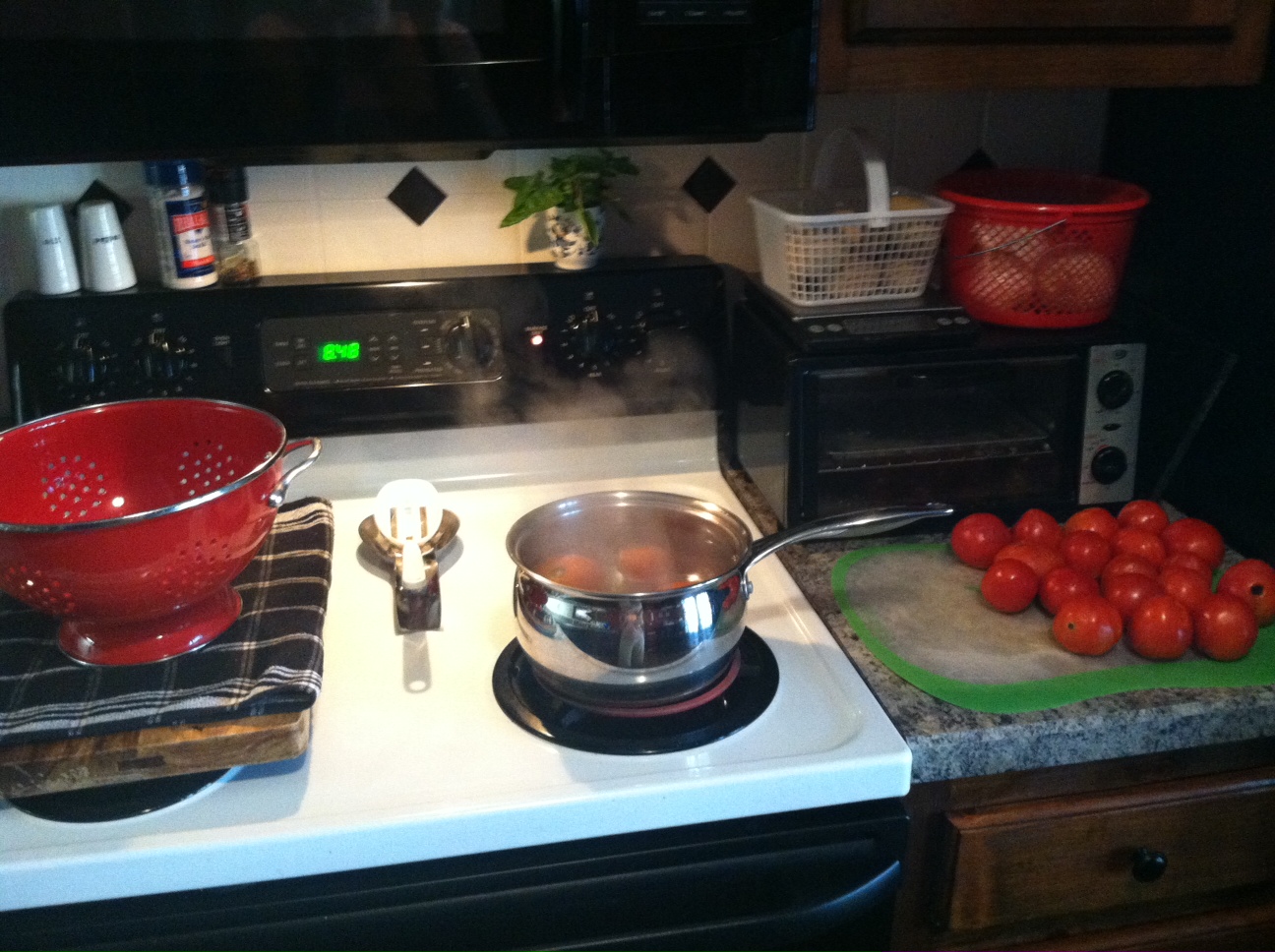
Mise en place!!
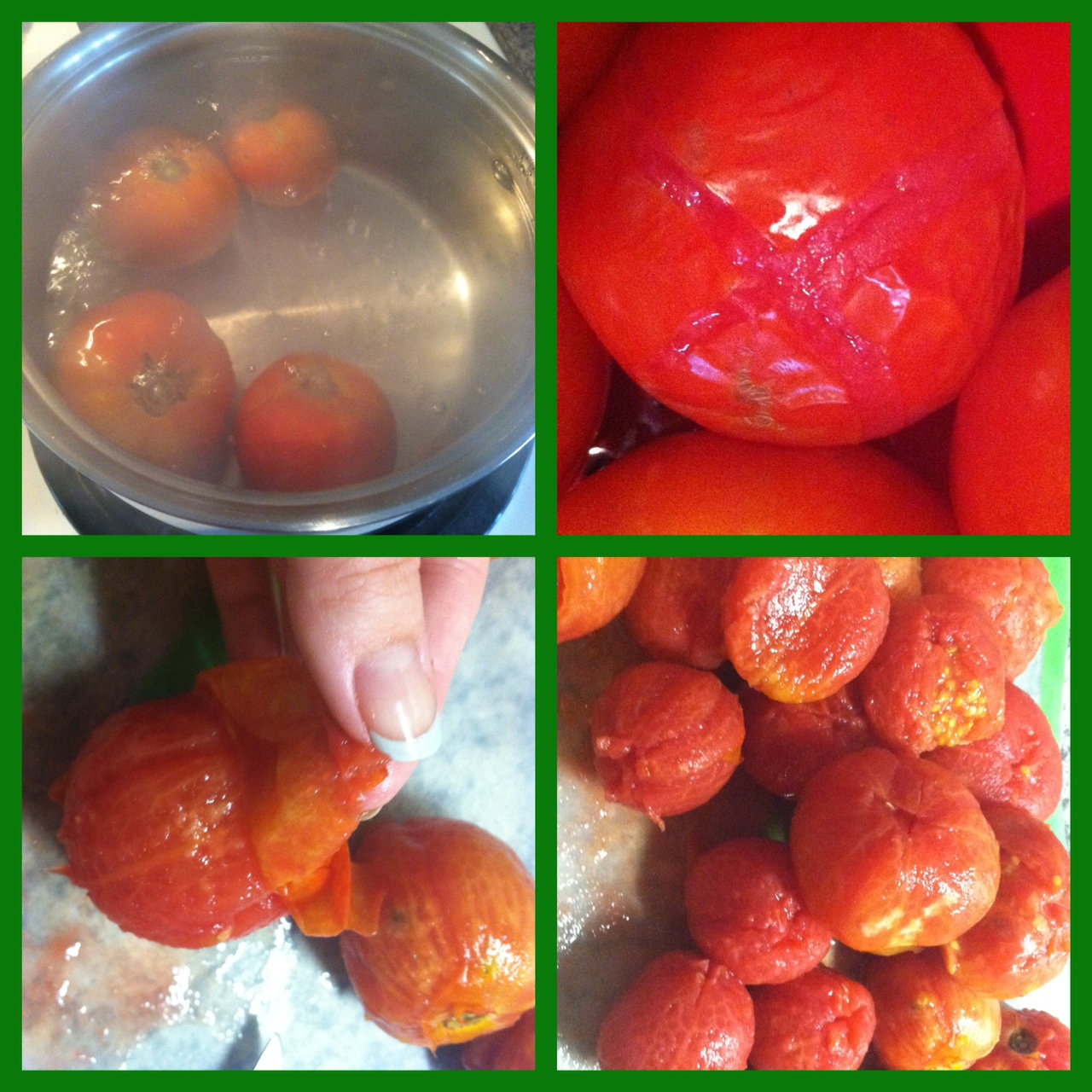
 

blanch and peel the tomatoes

Once you’ve done this in small batches to all of your tomatoes (don’t put more than 4 or 5 small tomatoes into your water at once), and once they’ve cooled to the touch, peel the tomatoes starting at the X in the bottom, pulling the skin away up to the top. Do this to all of your tomatoes. Once they are all peeled, start chopping and you’ll want to remove the hard area of the tomato where the stem was. Everything else gets chopped and thrown into your pot.
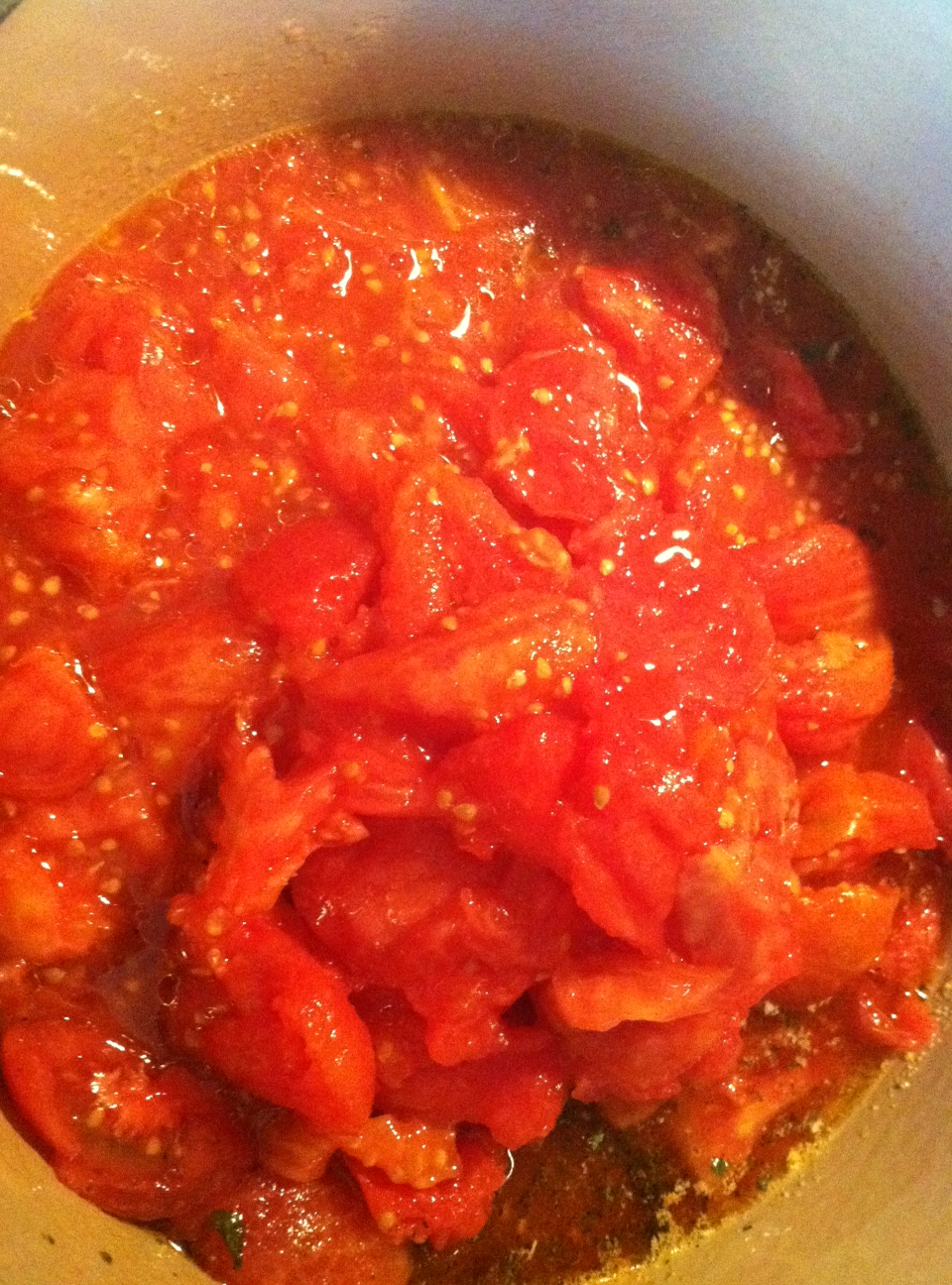
dump chopped tomatoes into your pot

Then you add your other ingredients (these measurements are based on using 3 1/2lbs of tomatoes):

  • 1/4 cup of olive oil
  • 3/4 tbs black pepper
  • 1/2 tsp chili powder
  • 1/2 tsp salt
  • 1/2 tbs minced onion
  • 1/2 tbs dried oregano
  • 1/2 tbs garlic powder
  • 1/2 tsp dried parsley
  • 1/2 tsp sugar
  • 2 tbs tomato paste
  • a few dashes of crushed red pepper flakes

You can use fresh herbs rather than dried herbs, but you don’t need too much. Remember, this is tomato sauce – a base, not your finished product that goes on your spaghetti. Also, if you don’t care for spice AT ALL, omit the chili powder and red pepper, but those two ingredients don’t really make this that spicy, so if you’re OK with a little spice, no worries.

Then the fun part. You probably don’t want your tomato sauce this chunky. If you do, awesome, move on to the next step, but if you’re like most people, you want a smooth sauce and you can accomplish this one of two ways: with a stick blender right in the pot, or with a regular blender in batches. I use a stick blender, because I feel bad ass when I open this thing up.
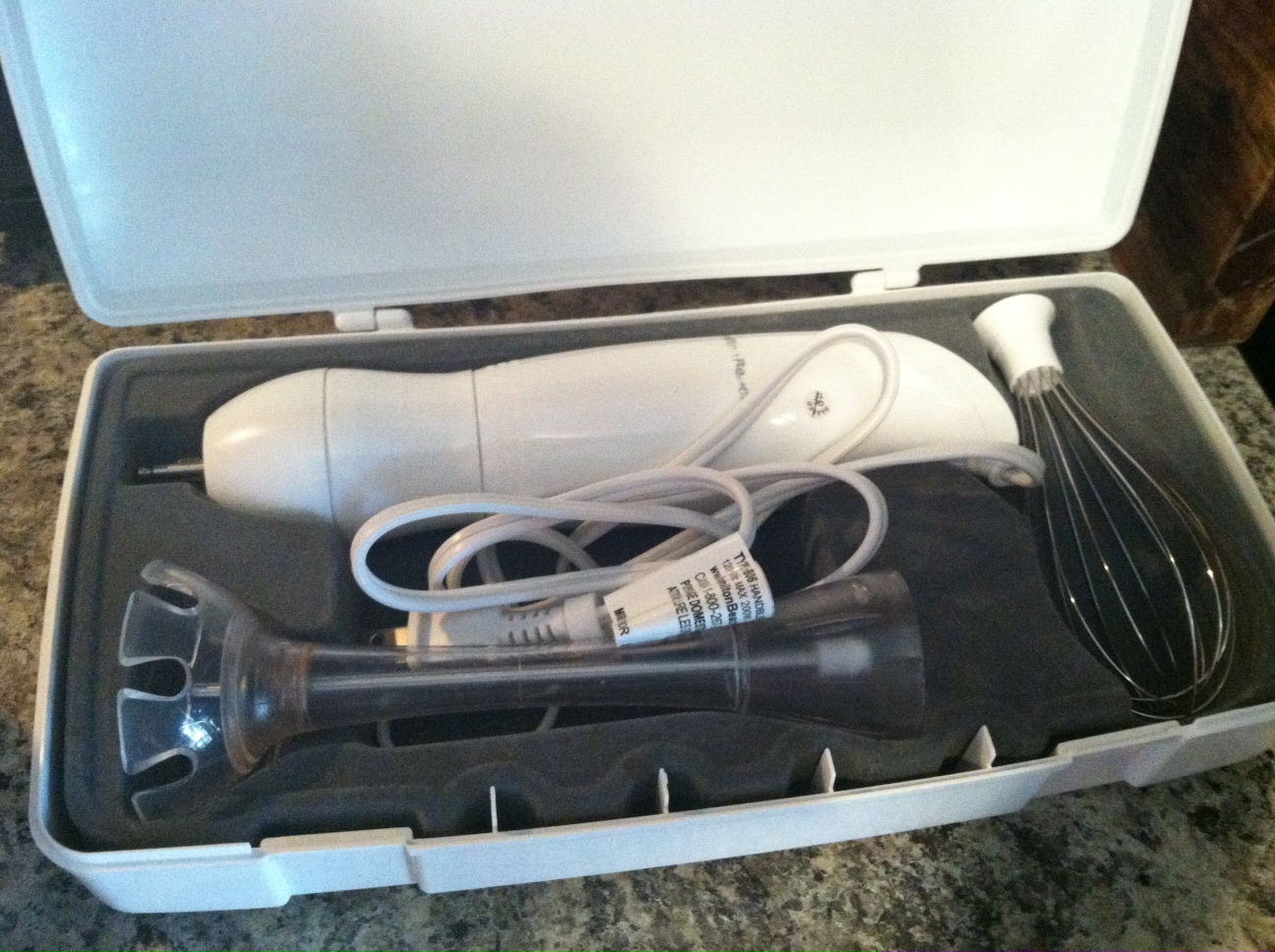
The 007 theme music starts playing

Seriously, it looks like a weapon custom designed for James Bond. But if you don’t have one of these, then just use your standard blender, blending in batches and returning the mixture to your pot. Do this before the sauce gets hot so nobody gets hurt.

After it’s been blended, simmer your sauce for at least an hour, or longer. It should look something like this:

droooool

If you’re using it right away, then do whatever you need to do, but if you’re freezing it, let it cool, off the heat for 15 minutes or so. Then dole out 1 cup portions into tupperware containers that are freezer-safe. Make sure you leave enough head room in each container – this stuff will expand, according to the laws of science. I buy tupperwares that have measurements right on the side of the container so I don’t actually have to measure, because we all know how I feel about that. I just ladle it in until it hits the mark.

Ready to chill out

Stash them in your freezer and pull them out whenever needed. To thaw, either put in the fridge overnight or let them float around in some cool water in the sink for an hour or so. Or if you’re super impatient like me, just dump the frozen sauce right into your pan and heat it up until it’s thawed. Look guys, I just need my tomato sauce RIGHT NOW.

You may be thinking that this is a lot of work, and so be it. It is. But the taste is amazing, you’re preserving a little piece of summer and perhaps you are not aware of the health implications of most canned food? Did you know that Bisphenol A (BPA) is widely used as a lining for cans holding canned food? BPA is thought to be harmful because it mimics human hormones and has been classified as an endocrine disruptor. BPA has been associated with a variety of health problems in laboratory animals, including cancers, early puberty, and developmental problems. Canned products are also laden with sodium (hello high blood pressure, blood clots, heart disease, etc etc etc) and other preservation chemicals. So avoiding canned products could be a life saver. There are a few small organic companies making canned beans and some veggies that are in BPA-free cans, but they are difficult to find and can be expensive. In the meantime, spend a little extra time to know and make what you’re eating. And if you’re NOT like me, and you are capable of following intense directions, start thinking about canning – which of course, is actually “jarring” and so avoids the BPA, sodium and chemicals in store-bought products. The Ball Jar website has great recipes and tutorials on how to do this. If I can ever get my brain to function on a linear plane, I may just try it myself.

Salmon: not just a horrible beach-house color

I try my hardest to eat salmon every week. Not because it’s my favorite fish, or because I think the Alaskan fishing industry needs my patronage (even though they do – do you hear me, Alaska? You NEED me!), but because it is super super super good for your brain. Alzheimer’s runs in my family, so we are all always looking for ways to prevent it. Recently, the link between omega-3 fatty acids and Alzheimer’s prevention has become clear. According to the Rush University Medical Center, people who eat fish one or more times a week are approximately 60 percent less likely to experience Alzheimer’s disease than those who rarely eat fish. The important thing about fish here being the omega-3’s, which salmon has a particularly high amount of. And omega-3’s in fish are of a particular kind called DHA and EPA, which appear to have the strongest health benefits. So what is it exactly that omega-3’s in fish oil are doing that are so beneficial besides making you smell like fish all the time? What, you don’t think of that as a benefit? Trust me, if you ever want to get out of a conversation, or need to rid yourself of a “close talker,” or are trying to attract stray cats, or just generally need the public to leave you alone, fish oil is a HUGE benefit. But in addition to that, these fatty acids reduce inflammation in the body. Inflammation is one of those things that can lead to myriad diseases including high blood pressure, heart disease, blood clots, stroke, dementia (Alzheimer’s), arthritis and much more. Another interesting potential benefit of omega-3’s? They may help fight depression. Although the studies are mixed, it is clear that in countries with higher levels of omega-3 in the typical diet have lower levels of depression. Eat fish; be happy.

Our bodies do not naturally produce omega-3’s – we must consume them through our diets. And while you can do this through a supplement, why wouldn’t you just do it through delicious food? Enter: salmon. Enter: my long speech about the right kind of salmon to buy at the fish counter. If you would like to skip this wild vs. farmed fish debate, skip to the last sentence of this paragraph. At just about any fish counter of any grocery store you will see 2-3 different varieties of Salmon. Some will say “wild caught” some will say “farmed” some will even say “organic”, but here are a few differences: farmed fish are raised in feedlots and at feedlots fish are doused with antibiotics and exposed to more concentrated pesticides than their wild kin. Additionally, farmed salmon are given a salmon-colored dye in their feed, without which, their flesh would be an unappetizing grey color. And regarding the all-important omega3’s? FDA statistics on the nutritional content (protein and fat-ratios) of farm versus wild salmon show that the fat content of farmed salmon is excessively high–30-35% by weight, wild salmon have a 20% higher protein content and a 20% lower fat content than farm-raised salmon, farm-raised fish contain much higher amounts of pro-inflammatory omega 6 fats than wild fish. IE – the opposite of what omega-3’s do for you. In studies by the FDA wild fish were not only much lower in overall fat content, but also were found to have 33% more omega-3 fatty acids than their farm-raised counterparts. Omega-3s accounted for 29% of the fats in wild coho versus 19% of the fats in cultivated coho. Bottom line: buy wild-caught fish.

I’m so sorry. Here are some pictures of food.


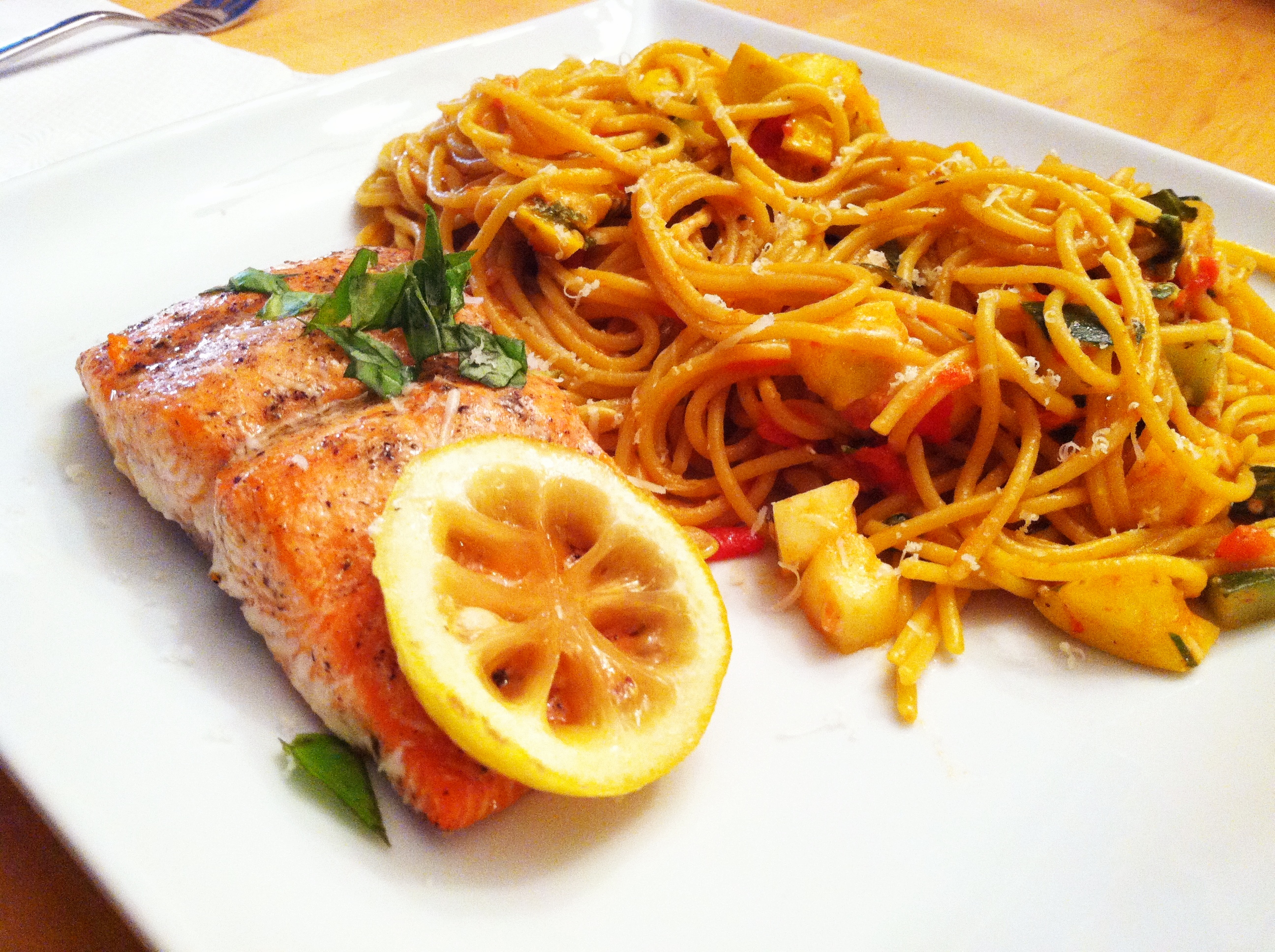
This was one of those recipes that came to me during this thing that happens in my mind where whatever fresh produce I picked up at the farmers market that week inserts itself into some recipe I’ve been drooling over on Pinterest. In this case, it was a tomato pasta recipe from Martha Stewart. But because I had zucchini and squash on hand and because I needed my weekly salmon, I mixed it up a little. I pan sauteed two small tomatoes, a small squash and small zucchini in olive oil with a teaspoon of minced garlic and some Italian seasoning. In the meantime, I rubbed the salmon down with lemon infused olive oil, salt, pepper and a little garlic. I heated some oil in a pan and laid several slices of lemon down into the oil, then placed the salmon on top, covered with a lid and let cook over medium-high heat while the pasta was boiling (about 8 minutes, or until it can be flaked with a fork). I have started using this Ronzini brand “Garden Delights” vegetable spaghetti – it is much more palatable to me than whole wheat pasta and still better for you than regular pasta, but you can use any kind you’d like. (Disclaimer: I did not get paid to promote Ronzini brand “Garden Delights” vegetable spaghetti, but I totally would if they offered. That goes for you too, Pacific Salmon Fishers of America, Sunkist lemon farms, and the people who make the ridiculously expensive lemon infused olive oil I use. )

I saved about a half a cup of the pasta water and made a sauce from the vegetables with some additional olive oil, Parmesan cheese, some freshly chopped basil from my garden, and a bit of the starchy pasta water, then mixed the pasta into it and topped with the salmon, a sprinkle of cheese and basil and a squirt of fresh lemon juice.

feed your brain!

And before you go off thinking I’m Martha Stewart, or Barefoot Contessa or something (although I think we can all agree that Jeffrey would just ADORE this meal), let me quickly correct you. I’m more like Julia Child’s slow second cousin. If Julia was forever dropping chickens or spilling this or that in some hilariously charming way, all the while making the most delicious French food you’ve ever seen, I am the slow second cousin who is nearly cutting off a finger or giving herself third degree burns while she tries to make toast. Case in point:

I need adult supervision.

I don’t know how well it comes through in that picture – but my middle finger has a pretty significant burn/blister right under the knuckle. This is because, as it turns out, metal skillets that have just come out of 400 degree ovens are HOT! This is my primary mistake in the kitchen – forgetting that things are hot and grabbing them with my bare hands. Also, over-salting things. So, Food Network, if you are looking for a new cooking show that appeals to those S&M loving, 50 Shades of Grey reading freaks, I am your girl. Get in line behind Ronzini and those stinky fishermen.

Get to crackin’

Let’s talk crabs. Of the crustacean sort, of course.

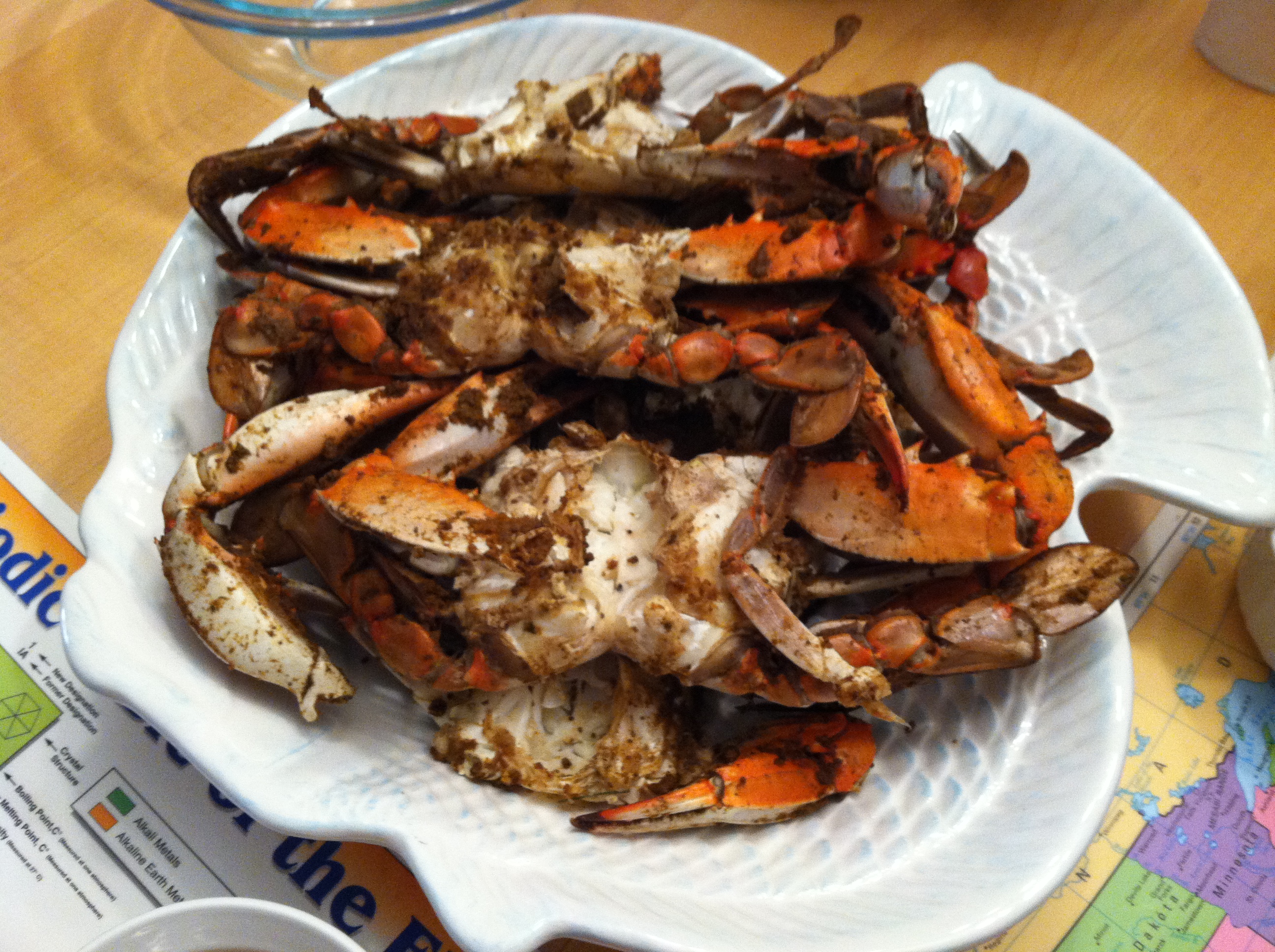
Blue crabs fresh from the Currituck Sound

Blue crabs are a way of life here. They are how many people, my uncle included, have made a living on the local waters. Growing up around bays where blue crabs thrive means that you learn how to crack a crab claw open before you learn how to use a fork, and I’m not kidding. Which brings me to one of my food obsession: food that takes a lot of work for a little bit of food. Crabs, shrimp, oysters, even pistachios – I LOVE eating food that is a challenge. There’s a sense of accomplishment, for one thing. It also extends the meal itself. Ever eaten a bushel of crabs with a small group of people? Two hours later and you’re wondering why there is still half a bushel of crabs left.  It forces you to relax, take your time, enjoy the company, the food, and everything else that entails.  Which is good, because for nearly $100/bushel, you should really, really enjoy them.

These crabs were caught by my (2nd? once removed? who knows) cousin, Mason who learned to crab from my uncle Wayne – his grandfather. They were delicious (both times) and I never take for granted the amount of work, from the crab pot to plate, that this kind of meal requires. Of course, you can’t have crabs without beer . . .

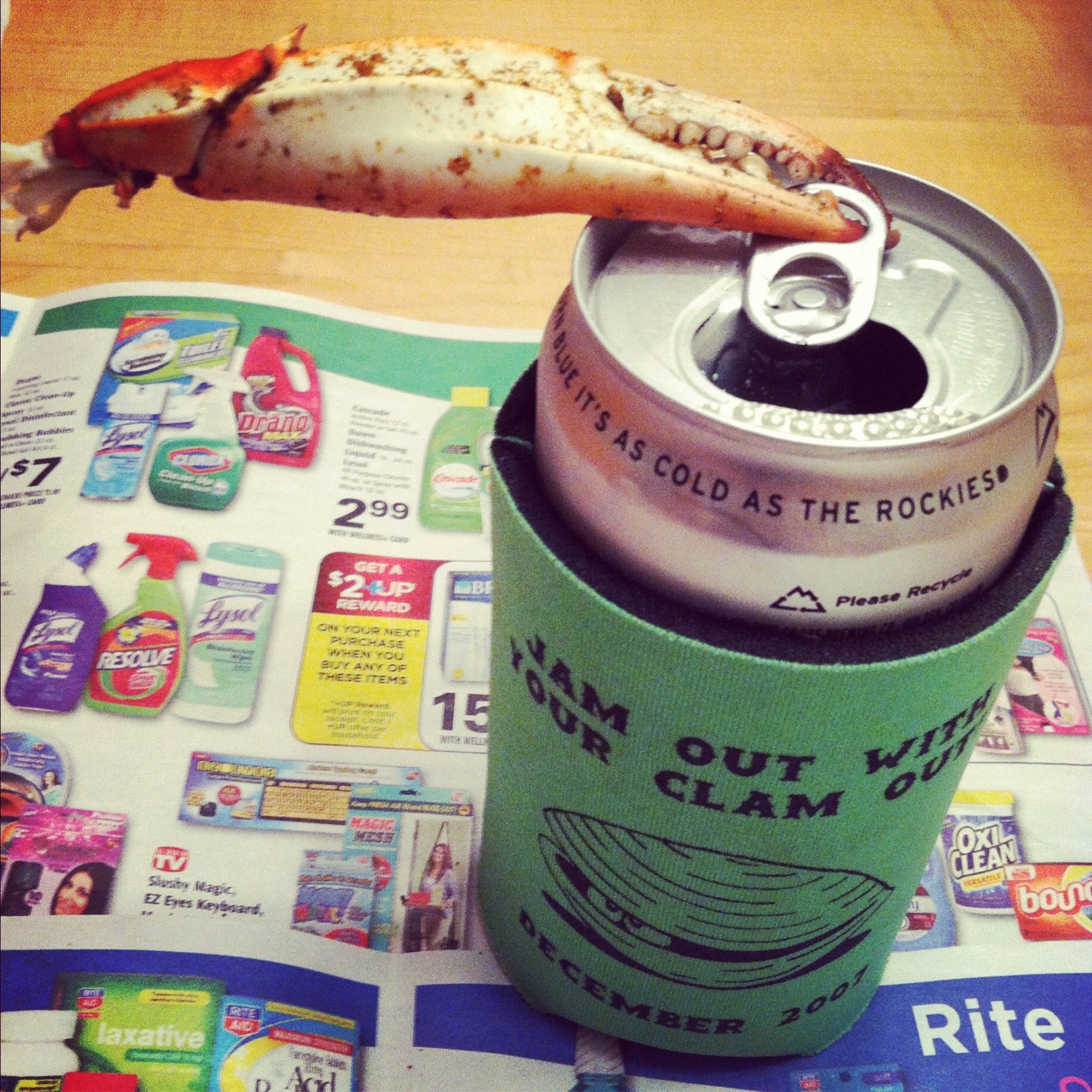
Crab claws make great beer-tab openers

I can eat crabs all by themselves….without stopping….for days on end….but I did decide to make a little cucumber and tomato salad with some local produce I’d gotten at the farmers market. One cucumber, halved, seeded, and cut into half moons, with halved cherry tomatoes in a sauce of Greek yogurt, dill from my garden, lemon zest and juice, garlic, salt and pepper.

Tomato and cucumber salad in Greek yogurt dressing

It’s a fun table to set: crabs, beer, fruit salad (local watermelon and peaches) and tomato and cucumber salad.

Crab dinner

And of course, we eat our crabs Carolina style – dipped in apple cider vinegar with salt and pepper. Another thing about growing up around here is learning to stomach, then appreciate apple cider vinegar. It goes on everything: BBQ, crabs, vegetables, collard greens – you name it. But did you know that it’s has some pretty serious health benefits? From WebMD.com “The effect of vinegar on blood sugar levels is perhaps the best-researched and the most promising of apple cider vinegar’s possible health benefits. Several studies have found that vinegar may help lower glucose levels. For instance, one 2007 study of 11 people with type 2 diabetes found that taking two tablespoons of apple cider vinegar before bed lowered glucose levels in the morning by 4%-6%.” Blue crab meat is also a great source of protein and is low in fat. It’s also a pretty amazing source of vitamin B-12, zinc, calcium and other nutrients. It’s also a good local “Sensible Seafood” decision, according to the Virginia Aquarium’s Sensible Seafood guide. But it’s important to note that what is a “sensible seafood” can vary by region, so while it’s sustainable here, it may not be in other parts of the country or world. Check out the original Sensible Seafood program at the Monterey Bay Aquarium’s Site.

What are your favorite foods that you have to work for? 

BERKFERST NOT MAH FAVRIT MERLS

If you need context for that title, check this out.

Breakfast is hard. Mostly because I don’t get hungry until about 11, but they tell you you’re supposed to eat within 30 minutes of waking up to boost your metabolism. I’ll be perfectly honest here and say that sometimes 11 and “within 30 minutes of waking up” are not always that far apart….but that aside, sometimes I just want a cup of coffee and for everything else to somehow make itself. Also, since I don’t really care for breakfast (on the weekdays – weekends are another story full of bacon and cheesy scrambled eggs and toast with strawberry jam), I try to make it as healthy as possible since my taste buds haven’t always totally woken up.

Last week I had gotten a few local peaches from my co-op and when I got up that morning, somehow all the cereal, bread, jam, and milk had magically disappeared. So I opted for oatmeal with peaches. I told you when I started this blog, there would be some major fails. This one wasn’t major, but it was a misstep – the directions on the oatmeal said to add a 1/4 tsp of salt to the oats while they were cooking. I cut the recipe in half, since it was just me and just threw in a “dash” of salt. Well, either these instructions are bobo to begin with, or my brain is so dysfunctional in the morning that my “dash” was actually a giant pour and this was the saltiest oatmeal I’ve ever had in my life. I tried to add some cream and honey to it to tone it down, but to no real avail. I ended up just mostly eating the peaches with a little bit of the oats. My advice: just don’t put salt in oatmeal. Seriously, whose idea was that anyways?

In any case, I think it turned out “pretty” which is sometimes all I can ask of my food:

BERKFERST

Local honey and peaches with rolled oats

So despite the salt-lick fiasco, let’s talk about the benefits of this meal while pretending it didn’t taste gross. First off, oats are a whole grain, and rolled oats are a less processed version of a whole grain. I’d like to say I can stomach steel cut, as-little-processing-as-possible oats, but I can’t. They’re just gross and should be reserved for horses. Thick rolled oats are my in-between healthy option. I get this brand from the organic/natural aisle of the grocery store. They take 10-20 minutes to cook. Word to the wise – if your “whole grains” take less than 5 minutes to cook, they aren’t really doing you any good. Whole grains are good for your heart, cholesterol, blood pressure (reducing the likelihood of having blood clots, stroke and heart attack), and provide you with folic acid, fiber, b vitamins, iron and more. You can find out more about the benefits of whole grains on the whole grain council website.

Honey is full of antioxidants, is a great way of sweetening food without giving you a sugar rush because of its quick glucose and slow fructose release and if you suffer from seasonal outdoor allergies, locally produced honey can help curb some of those issues because it gives you a healthy, low-dose of the pollen you are allergic to, sort of like a vaccine or an allergy shot would. Find more fun honey info here.
Locally produced honey is the best kind to get (of course) because it will provide your system with the local allergens and pollen, because it helps keep your local honey bee population thriving (which is incredibly important for agriculture overall) and because it taste better because it has to go through less processing. I buy mine from Bee’s Knee’s apiary here in Chesapeake, VA.

Finally, peaches. Ah, peaches. The epitome of July. The highlight of summer. Who would even care if they had health benefits or not, they are so good? But, luckily, they are full of potassium (low potassium is the source of MANY health issues including hypertension, fatigue, muscle weakness and more), beta-carotene (which your body turns in to Vitamin A), lycopene and lutein. They are also high in fiber and vitamin C. It’s important to note that while almost all vegetables and many fruits are “high in fiber” – the fiber usually resides in the skin of the product. Some fiber is contained in the flesh, but when it comes to things like peaches, cucumbers, apples, etc – if you are peeling them before eating them, you are losing out on a lot of fiber and nutrients. Whole food is the best food.

Alright, that’s enough for today’s nutrition lesson. Just remember – skip the salt, use a minimally processed whole grain, leave your fruit’s skin on and skip the sugar and replace it with locally produced honey. And coffee….don’t forget the coffee…..

To meat or not to meat

I realize that all my posts so far have probably given the impression that I am a vegetarian, which I’m not.  I was for several years in college and then I got married and this is how that story goes: We got back from our honeymoon and the next morning Jeremy fried bacon in our newly-shared apartment. End of story. If you can resist the smell of bacon after 7 days of eating Jamaican food, you should probably see a doctor, cause something is wrong with your olfactory system.

Although I do eat meat now, I still try to reduce my meat consumption as much as possible for several reasons including health, cost and the impact meat has on the environment. This is nothing new – there’s a whole “Meatless Monday” movement, in fact.
Most of the meat we do eat is locally raised – Hampton Roads has several wonderful farms producing high-quality, ethically-raised, pastured and free-range, hormone and antibiotic-free meats including beef, pork, chicken, lamb, goat, rabbit, and turkeys. Seriously. Although none of that matters much for this post, which is yet another vegetarian meal. One day, I promise, I will share a meat recipe.

This recipe came from a Rachael Ray inspiration. I don’t generally watch her show (or any daytime television) and I have a huge grudge against her for making the whole world think that ALL RACHELS spell their name RACHAEL – which just isn’t true. But I was at the dentist one day, confined to a chair with a TV in front of it and her show was on. She was making a pasta dish where instead of a traditional sauce, she roasted an eggplant and used the eggplant-meat as a sauce. Then she slapped some real meat on top of it, but that seemed unnecessary, so a few nights ago with an over-abundance of vegetables from my co-op, including a beautiful eggplant, I decided to riff on this idea.

eggplant Rotini

roasted vegetable rotini with eggplant sauce

There is one thing I share in common with Rachael Ray, and that is a tendency to not really have a “recipe” but instead to use kind of general directions and measurements. I once saw her instruct in a recipe to use a “palm-full” of something, and that is definitely how I cook. Measuring and following directions takes precision and patience – two things that I do not possess. It’s why you’ll never see a baking recipe on this blog.
So below is my best re-construction of what I did here.

Eggplant Rotini with Roasted Vegetables

Serves: 2 hungry people. Double for your fam.

Ingredients:

  • 1 Medium Eggplant
  • 1 small/medium zucchini
  • 1 smell/medium yellow squash
  • 1 large portobello cap
  • 1 small onion – red, yellow or white is fine
  • a handful of snap beans
  • 2 large cloves of garlic, minced
  • a handful of fresh basil
  • olive oil
  • 8 oz (half a box) of whole wheat rotini or other curly pasta
  • Parmesan cheese

Directions:

  1. Cut the eggplant in half, lengthwise, brush the cut sides with olive oil, then sprinkle with salt and pepper. Lay, cut side down, on a rimmed baking sheet and put in the oven at 375 F for about 30 mins.
  2. Take all of your veggies that you are putting in the pasta (I listed what I used above, but feel free to improvise or substitute here with whatever you have on hand), cut into pieces, mince one clove of garlic and dump it all into a bowl and coat with olive oil, salt, pepper and a little Italian seasoning, if you’d like. Pour onto a rimmed baking sheet. Stick in the oven with the eggplant for 25-30 mins of until they are done to your liking (I like mine to still have some bite, without tasting raw)
  3. When the veggies only have a few minutes left, start the pasta – cook according to package directions. Save half a cup of pasta water before draining.
  4. Take the eggplant out of the oven and let cool for a few minutes. The halves should look “deflated” and the inside should be runny and almost liquefied. Once they are cool enough to handle, scrape the insides of the eggplants out into a medium sized bowl and with the flat end of a wooden spoon, mash the eggplant. Stir in the other minced garlic clove, salt and pepper to taste, and Parmesan (a palm-full??), then stir in freshly torn or cut basil, stir until you have a nice paste going. (You can see a picture of this in the collage above, upper left-hand corner).
  5. Add the drained pasta to your eggplant paste and stir – adding in the reserved pasta water until the noodles are coated in a starchy sauce (you probably won’t need the whole half cup). Take the roasted veggies out of the oven and toss them into the pasta as well. Grate in some more Parmesan and mix. Top with fresh basil and little extra Parmesan.

We had this with some locally made hummus and whole wheat pita chips. This roasting and mixing method really takes the bitterness out of the eggplant that keeps a lot of people from eating this super-nutritious veggie. Eggplants are low in Saturated Fat and Cholesterol; they’re also a good source of Vitamin K, Thiamin, Vitamin B6, Folate, Potassium and Manganese, and a very good source of Dietary Fiber. The fiber in the eggplant, the other veggies and also in the whole-wheat pasta (about 6 grams per cup) make this a super filling meal. Fiber is known for keeping you full for longer, so you don’t have to eat as much of it in the first place, and then you’ll be less tempted to have a midnight snack later.

So don’t get me wrong – meat is great. But when it’s mid-July and I’m looking at all those beautiful vegetables, I can’t help but go back to those pre-bacon days and let the produce steal the show.

What is your favorite meatless meal? Are you reducing your meat consumption or are you a vegetarian? If so, what are your tricks for making filling meatless meals? 

Confessions, Exceptions, and Admissions

Eating locally can sometimes be a challenge. Especially depending on where you live. I’m really blessed to live in an area that makes an awful lot of amazing things, but I know that’s not everywhere. Then there are those brats who live in California where everything is available locally pretty much all the time and everyone gets it and does it and even the “fast food” joints serve local grass-fed beef. It’s really just infuriating. Or great. Or whatever – you know what I mean.

But being a “locavore” doesn’t mean that you have to give up everything that isn’t grown around you. It just means that whenever possible, you support your local food system. There are a few things I have accepted that I will never be able to acquire locally but that I will never, ever consider giving up. Here’s my short list:

  1. Coffee (duh)
  2. Olive oil (double duh – although, there is an olive farm in Georgia making some amazing oil, maybe that trend can move up to VA??)
  3. Lemons and Lime (I make a lot of mixed drinks and these are essential)
  4. last but not least – AVOCADOS  

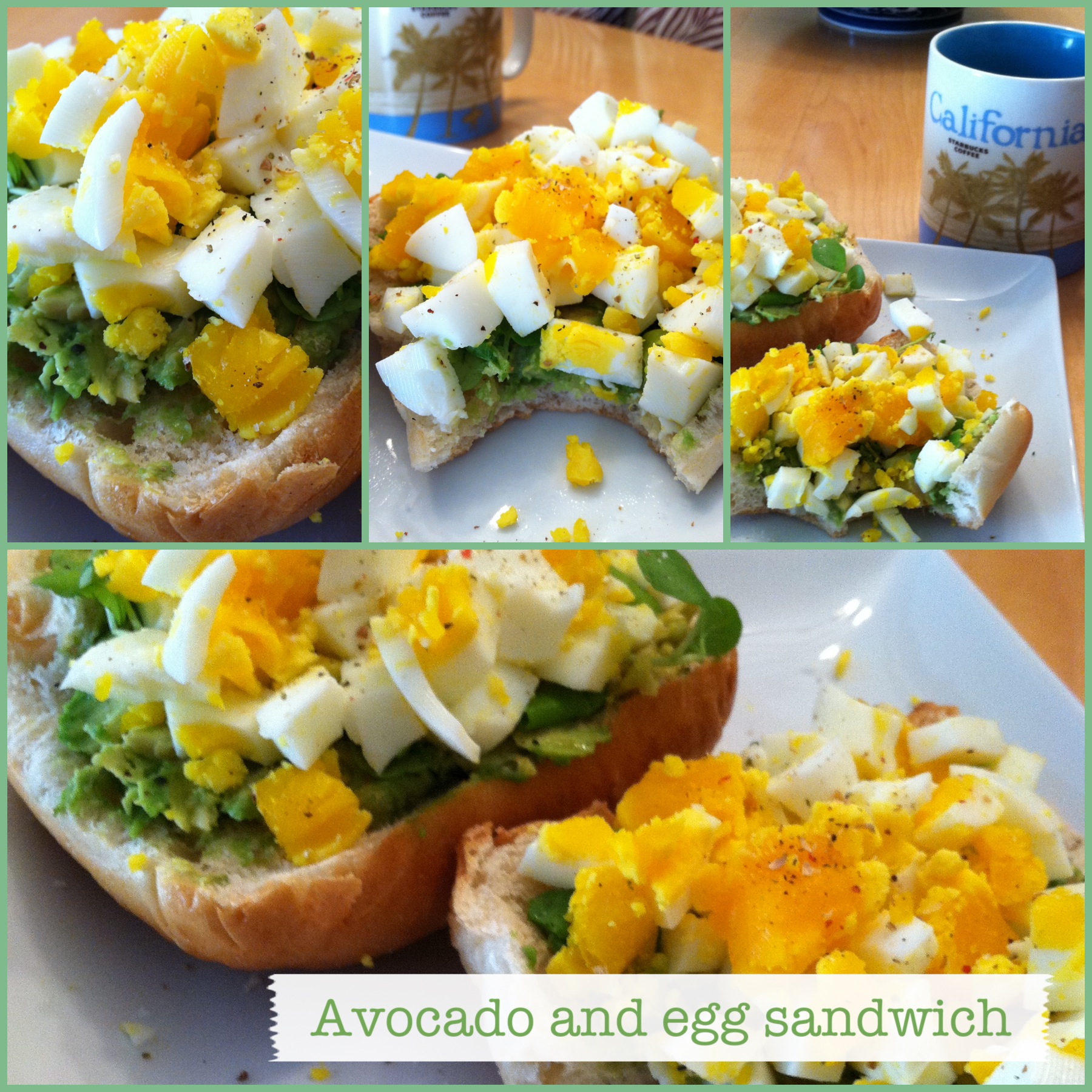
Avocados are kind of an obsession for me….they are this perfect combination of fresh, creamy, protein-laden, good-for-you-fats that just makes me happy. There will probably never be an avocado farm in Virginia, but I continue to buy these California imports on a weekly basis. This morning I was feeling an avocado craving coming on and I had one of these flashes of food inspiration that I get sometimes and I saw this sandwich in my mind before I even made it. It was a snap and was (obviously) delicious. Also, huge. It was huge. I ate about 60% of it and gave up. Which is sad. I hate leaving good food behind . . . 

Avocado and Egg Sandwich

Ciabatta bread topped with mashed avocados, watercress, chopped hard-boiled eggs, salt & pepper.

The app I use for these collages, by the way, is called “Pic Frame” and is available FOR FREE in the app store. The latest update now allows you to add labels, which makes the app complete perfection. Notice my shout out to California in the background 😉

The watercress and egg are both local, so see – it’s possible to combine the two without being a total traitor. The watercress just gave the sandwich the right amount of crunch and fresh green needed between those two heavy layers of protein. I only used half of an avocado spread on both halves of the ciabatta roll, so there’s still another half in the fridge waiting to be something yummy. I hard boiled two eggs, but I really only needed one. And if you don’t know – this is the absolute perfect method for making hard boiled eggs with yolks that are still chewy and flavorful instead of dry and chalky:

  • Put your room temp eggs into a sauce pan and pour room temp water over them until they are submerged.
  • Put the sauce pan (covered) over high heat and bring the water up to a boil.
  • When the water has reached a rolling boil, remove the saucepan from the burner, leave the lid on the pan and let the eggs sit for 6 minutes.
  • Using the lid as a strainer, strain the hot water from the pan, dump a few handfuls of ice into the pan on top of the eggs and let sit for 2 minutes.
  • Remove the eggs from the ice, roll across the counter until the shell is cracked all over, then peel. Cut as you’d like.

Avocados are widely regarded as one of the healthiest foods you can eat and particularly some of the best fat you can eat as it is primarily mono and poly-unsaturated fat, which makes it a great protein and fat supplement for vegetarians and vegans or just people like me who try to reduce their meat consumption. And we all know that eggs are a great source of protein. But not all eggs are created equal. In fact, several studies show that farm-fresh pasture raised chickens (which you will pretty much only find from local sources) are nearly 5 times higher in Vitamin D, have 1/3 less cholesterol, 2 times more omega-3 fatty acids, 3 times more vitamin E and the list goes on. And anybody who’s ever eaten a locally raised egg will tell you that the taste is the biggest difference. Eggs that you buy from the grocery store are “factory raised” eggs and even though they may be labeled “organic” “free-range” or “vegetarian-fed” it doesn’t mean what you might think. Thanks to the blog “Simple Bites” for explaining this quickly and easily:

“In order for eggs to be labeled “free-range” a chicken needs to have access to the outdoors.  This usually means hundreds of chicken confined to an industrial chicken house with a small slab of concrete to walk outdoors if they’d like. Your “free-range egg” chickens are really spending their lives indoors in a ventilated area and will not have the nutrient levels as described above.  If you’re buying “vegetarian-fed eggs”, this is a sure sign that they do not have access to pasture as real chickens are not vegetarians.”

And that’s that. Locally raised eggs are available all over and while their natural season is spring, they are usually available year-round thanks to heating lamps and modern amenities. Find out where to get yours at http://www.localharvest.org or several of the other links on the right-hand side bar on my home page.

Getting back to the sandwich: it was delicious, it was easy, it melded my favorite import with some of my very favorite local ingredients and just one roll, half an avocado, two eggs and a few sprigs of watercress probably could have fed me and Jeremy for dinner.

What are some imported foods that you can’t live without? What is your favorite thing to do with avocados? Are you eating locally raised eggs and can you taste the difference?
Leave me a comment and let’s chat!

Hello. Is it beets you’re looking for?

For the past two years I have worked with a local nonprofit organization focused on promoting local food and supporting small, family farms. For the past twenty-ish years I have been obsessed with food. Not like the people you see on Discovery Health who have to be lifted via crane out of their living rooms, but like an eight year old girl with a subscription to Martha Stewart and a dream to be a food stylist before that was even a thing and there were horrible reality shows about it. The dream of Culinary School turned into an English degree, and then another English degree, and while food is my primary passion, I’ve learned that cooking it is better kept as a passion, rather than a job. This blog was just a matter of time.

I think it’s important that chefs (and cooks!) have a philosophy, or at least an end-goal in mind when they’re creating and cooking (besides ‘I’m hungry. I think this box of mac ‘n’ cheese will do it’). For me, it’s always local. I’ve learned through the years that local food is more nutritious, tastes better, supports small farms in my community and offers heirloom and heritage varieties that you can’t find in the grocery store. When I cook, I always like to look to the local ingredient first, and then build around that. This blog will be a glimpse into some of the dishes I create, try, maul, derange, re-try and finally share with you. They will not all be good, but we’ll learn some lessons, techniques and things you may not have known about the local food system. I encourage you to comment, make suggestions and share your own experiences with me. And most of all, I encourage you to seek out local food in your own area. Once you start to look for it, you will be amazed at what is out there.

To get us started and whet our appetite, I offer up my most recent “Friday Foodie Freestyling” – which is what I do on Friday nights when the husband and I stay in and I have nothing to do except open a bottle of wine, peruse my box of fresh produce, and create a three or four course meal made primarily from whatever I picked up from my Thursday afternoon co-op, Coastal Farms.

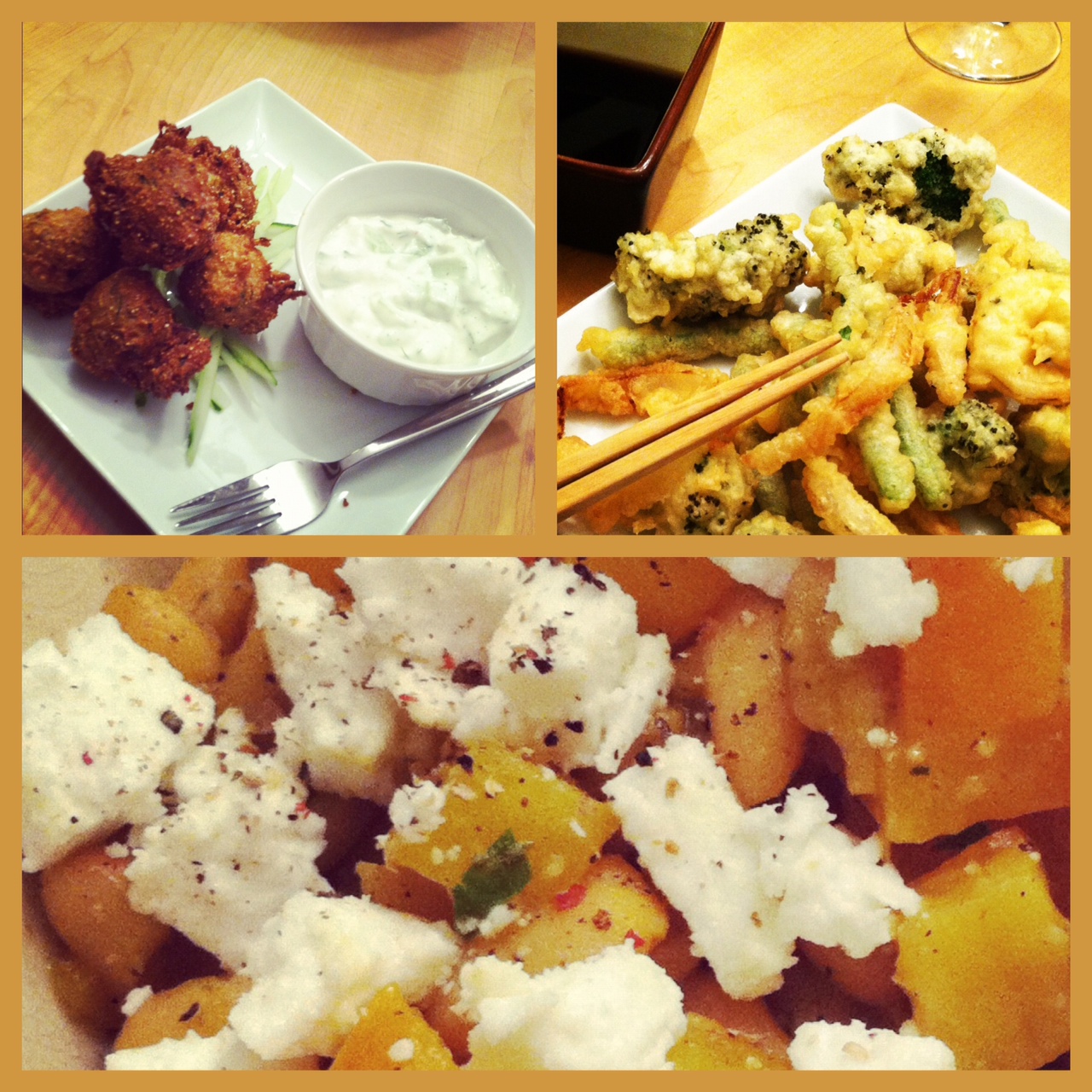
Friday Foodie Freestyling

Zucchini poppers with tzatziki, tempura fried snap beans, broccoli, and spring onions with ponzu, golden beet and white bean salad topped with VA goat feta.

Our first course was zucchini poppers or zucchini hush puppies. I made them with shredded zucchini (local, of course) and mixed that with a local egg, hushpuppy mix from Wade’s Mill in Raphine, VA where they still stone grind their wheat, some home-made pesto from my garden and a bit of Parmesan. I fried them in my deep fryer (my best friend and worst enemy) and served them over a bed of string-cut cucumbers and with tzatziki dipping sauce which I made from Greek yogurt, local cucumbers, dill from my garden and lemon zest.  They were OK. The Huz liked them more than I did, but despite my Southern roots, I’m not a huge hush puppy fan. I do love the tzatziki and consider anything that serves as a vehicle for it a bonus. (read: I can, and will, eat that stuff with a spoon and no shame).

Second course was golden beet (you know I ❤ them!) and white bean salad. My favorite method for cooking beets is to cut them off their stems, wash them, leave the skin on, wrap them individually in tin foil and then throw them in the oven – right on the rack – at 375 for about 45 mins. When they can be pierced all the way through easily with a knife, they are ready to roll. Take them out, let them cool a bit and then take a hand towel or paper towel and just rub the skin right off of them – it should slide off easily at this point. I diced the beets, mixed with the beans (canned) and heated it all up together along with an Italian vinaigrette, some fresh herbs from my garden then topped with VA made goat feta and cracked red and black peppercorns. This was yum and definitely worth repeating.

Finally the last course was tempura battered and fried fresh veggies. Tempura batter is literally one of the easiest things to make. There are four ingredients: flour, baking powder, water and egg. That’s it. Do NOT buy the pre-made tempura mixes at the grocery store for $4.50, it’s a total rip off. Once I made the batter, I dipped broccoli, snap beans and spring onion rings into it and then into the deep fryer (you see how I keep going back for more abuse…) and then out after a few minutes, served with ponzu dipping sauce (lighter and more citrusy than soy sauce – buy it pre-made in the International aisle at the grocery store). This is always good. I make tempura several times a year and it never disappoints.

So there you have it – that’s what I do and that’s how I do it. Keep checking back for more food pictures, recipes, tips and absurd failures. Thanks for reading!