Crock pot chicken

I am about to share with you one of my favorite recipes of all time. Why is it one of my favorites? There are a few reasons:

1. It is easy

2. It cooks in the crock pot

3. It uses lots of fresh, local ingredients

4. You do not have to remember to THAW the food in advance, which I am terrible at

5. It saves you MONEY

I can’t take credit for this recipe – it came from a local farmer who raises chickens and was interviewed in the local paper last year about how she likes to prepare her own local, pasture-raised poultry. This recipe is a very slight variation on her original, but I give all the credit to Alison Wilson of Full Quiver Farms. I knew I had to make this recipe when Julia Child’s 100th birthday came around a few weeks ago, and the infamous taping of her roasting a chicken was inescapable. She was a completely lovable spaz, and I feel certain, based on that footage, that she got salmonella more times than she could remember. But, despite all that, I wanted to make a chicken.

First, you SLAP the chicken!

This is a basic crock-pot chicken. But when done right, it is flavorful, can be used for several meals, and will provide you with nearly 10 cups of fresh, delicious chicken stock. Let’s get started.

As I mentioned above, you do not have to thaw your chicken first, which is possibly my favorite thing about this recipe. It’s so hard to remember to take something out of the freezer in the first place, and then when you get into the realm of poultry, trying to figure out how many hours it needs to thaw based on the pounds….well, that’s called Math, my friends, and I don’t ride that train. But because you can put the chicken into the pot frozen, it will take a full 8-10 hours to cook to completion, so keep that in mind – get up a little early to get this one in the pot, OR do it overnight and wake up to a house that smells like the inside of your grandmother’s kitchen on Sunday afternoon – both good options.

I used a 5lb pasture-raised chicken from G-square farms in Isle of Wight County, VA. I bought and received this chicken within a week of it being processed. It does come to me frozen, but it is still tender and delicious when cooked. I paid $16 for a 5lb chicken, which I realize is more expensive than a chicken from the grocery store, but I feel like I shouldn’t have to explain to you all at this point why it is better to pay a little more for a quality, ethically raised chicken. Plus, you’ll see how $16 is going to make 2-3 meals.

In the bottom of your pot, dump your mirepoix (a combination of sliced and diced celery, carrots and onions). I use one onion, two carrots and two stalks of celery. Cover the bottom with this mixture and season with salt/pepper and then toss in a few cloves of garlic (or if you’re me – an entire head of garlic), crushed.

On top of that mixture, place your frozen chicken. Make sure, if it has gizzards, that those are removed. Then, this is where my recipe varies – I top the chicken with as many fresh herbs as I have on hand from my garden. In this case, a tiny bit of oregano, sage, rosemary, thyme and chives. I also season the chicken with poultry seasoning, more salt and pepper. Then cover the whole things with water. Ideally, you want the water to come up over the top of the chicken, but just put in as much as you can without overflowing. Finally, the secret ingredient – add 1/4 cup of apple cider vinegar. According to Wilson, the vinegar helps draw out the flavor and nutrients from the chicken bones.
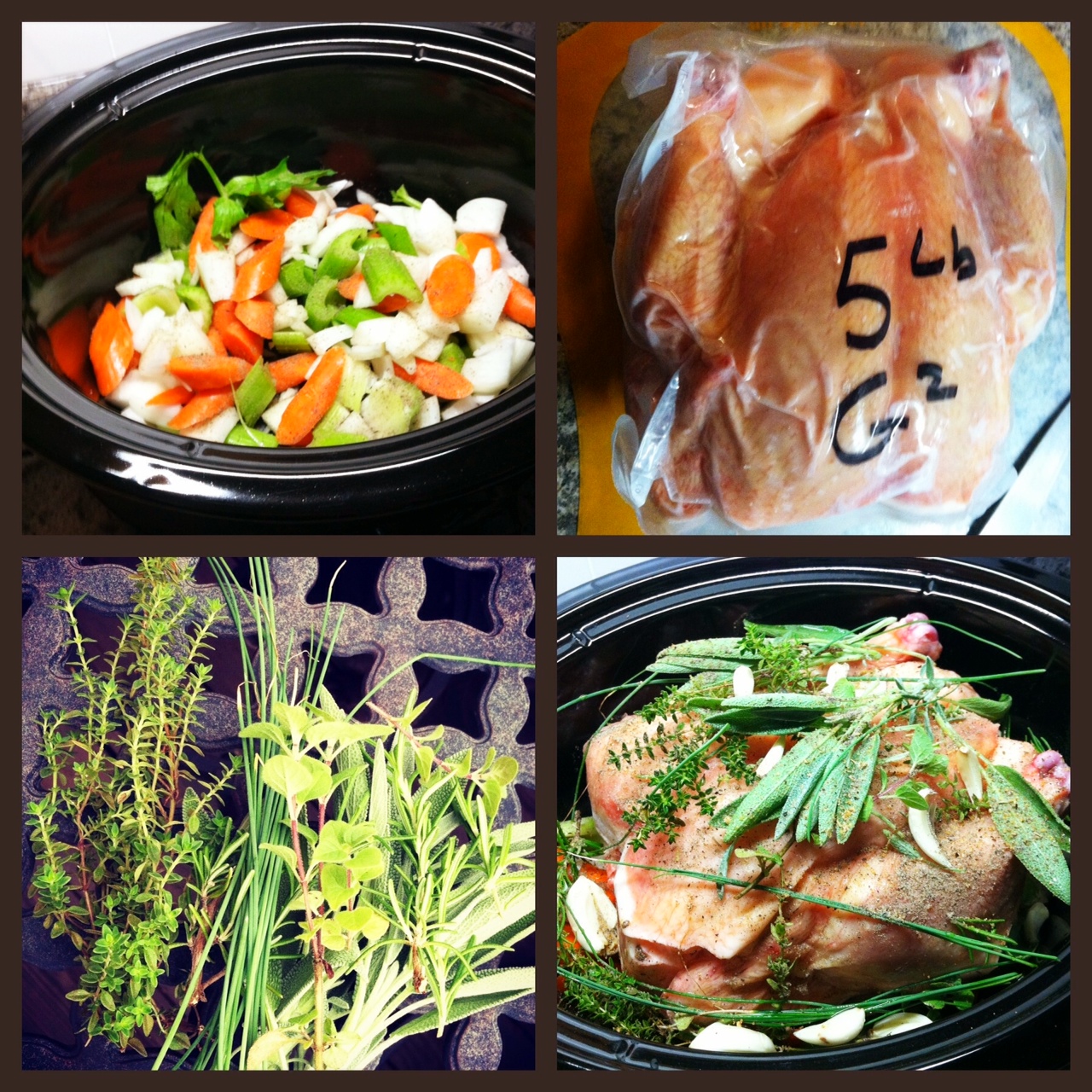
Mirepoix, pasture-raised poultry, fresh herbs, crock pot chicken!

Then….walk away. Just walk away. 8-10 hours later you’ll have something that looks like this:

Your final product(s).

Remove the chicken from the pot carefully with tongs – it will fall apart a bit, so just go fishing for the drumstick, which inevitably is the first thing to go. Set the chicken out on a rimmed baking dish and let it cool. While it’s cooling you can deal with the broth, but for the sake of explaining this picture – once it’s cooled, debone the chicken (this is the most time consuming part of this recipe). I separate out the dark and white meat, but do whatever you like here. Then I take out what I need for whatever I’m making that night and refrigerate or freeze the rest. I only needed about one breast and a bit of dark meat for that evening, the rest went in to tupperware and supplied TWO more dinners!

When you’ve removed your chicken from the crock pot, you’ll have broth and a whole lot of bits and pieces left. To separate the broth from the solids, place a sieve over a large measuring cup or container and use a ladle to strain the broth:

Look at you with your homemade broth!

Once the broth has cooled, I store it in different sized containers. I feel like recipes are always calling for just a 1/4 cup or a few tablespoons of broth, so I freeze an ice cube tray of broth, which I then pop out and store in a zip lop bag once they are completely solid – each cube is about 1 oz of liquid, so just pull out a cube at a time as needed for recipes. I also freeze 1 cup servings and then a large 4 cup container. The broth is naturally pretty low fat since we didn’t add any oil and pasture-raised animals are pretty lean, but if you’d like you can use a fat separator OR just store the broth in the fridge for several hours and skim the fat off the top once it’s congealed.

SO, now you have 10 cups of broth and an entire deboned chicken (I had about 8 cups of meat, but that will depend on the size of your chicken). What to do next? Well, I’m sort of a sucker for chicken wings, but let’s face it those deep fried, smothered in sauce, then dipped in another sauce appetizers are not doing anyone any favors. So here is my health(ier) take on buffalo wings.

Take one breast and tender and 1/2 cup of your dark meat and chop it up or shred it. Place it in a bowl and add 1/4-1/2 cup of buffalo wing sauce (depending on how saucy you want it). I use the Texas Pete brand because I think it’s spicier than others, and I’m not playing around when I want buffalo, but you can buy a milder brand. Then add 1/2 packet of dry ranch dressing mix. Mix well. From here, you can do whatever you want with this – put it on sandwiches, make a salad, whatever. I did lettuce wraps with iceberg lettuce, home made ranch dressing, shredded carrots, diced celery and crumbled blue cheese.

Buffalo chicken and accouterments.

Served along side some local corn on the cob and home made potato chips made from local potatoes, oh and of course a Corona with lime . . . whoa.

There isn’t a bar in town with buffalo chicken this good.

This recipe used about 1/3 of the whole chicken and served two people for dinner and then two people for lunch the next day. Another 1/3 got used in a chicken pot pie, which three very hungry people consumed in one meal, and then the other 1/3 is in my freezer – just waiting to become something else delicious. I use the chicken stock in everything, and barely ever have to buy it from the grocery store because I make a crock pot chicken once or twice a month, keeping me stocked with . . . stock.

Recipes like this just make me happy – they are a breeze to do, they work on so many different levels, they give you two products for the price of one and will feed you for a week.

What are your favorite dual purpose recipes? 

Try, try again

One of my favorite cooking traditions is on the weekends when Jeremy and I get up and make breakfast together, side by side at the stove – him frying bacon and me scrambling eggs. But this past weekend he was out of town and to console myself, and to keep from eating obscene amounts of bacon, I decided to get a little inventive with breakfast. I had dropped by Trader Joe’s late last week after dropping Jeremy off at the airport and scored (among many, many other things) some great smoked salmon and a bag of ripe avocados. Somewhere in the back of my mind a light bulb flickered: salmon and avocado crepes. OK, so I don’t exactly bake, and making crepes feels like baking – there is flour sifting involved. So I made some pancake mix work for my purposes and here’s what I came up with:

I used the pancake mix, with a little more almond milk than it called for and a plop (yes, a plop is a technical cooking measurement) of Greek yogurt, lemon zest and a squirt of fresh lemon juice. I poured that into a non-stick skillet very thinly and swirled the pan to cover the bottom, flipping after only a minute or so. Then I smeared a cream cheese/herbed goat cheese mixture on the crepe, laid out some smoked salmon and avocado slices, then rolled up and topped with another plop of yogurt.

Verdict? Meh. Yeah, I admit, they look amazing. You would easily pay $12-15 for this plate at a restaurant, and maybe if I had I would have thought more highly of them, but something about the mouth feel of so many “creamy” things wasn’t doing it for me. Salmon, avocados, creamy cheese and the soft cake was all just a little too much. I was hoping the yogurt would tang it up a little, but it was too little, too late. Probably plenty of people would love this, if that flavor profile works for you, but it just doesn’t for me.

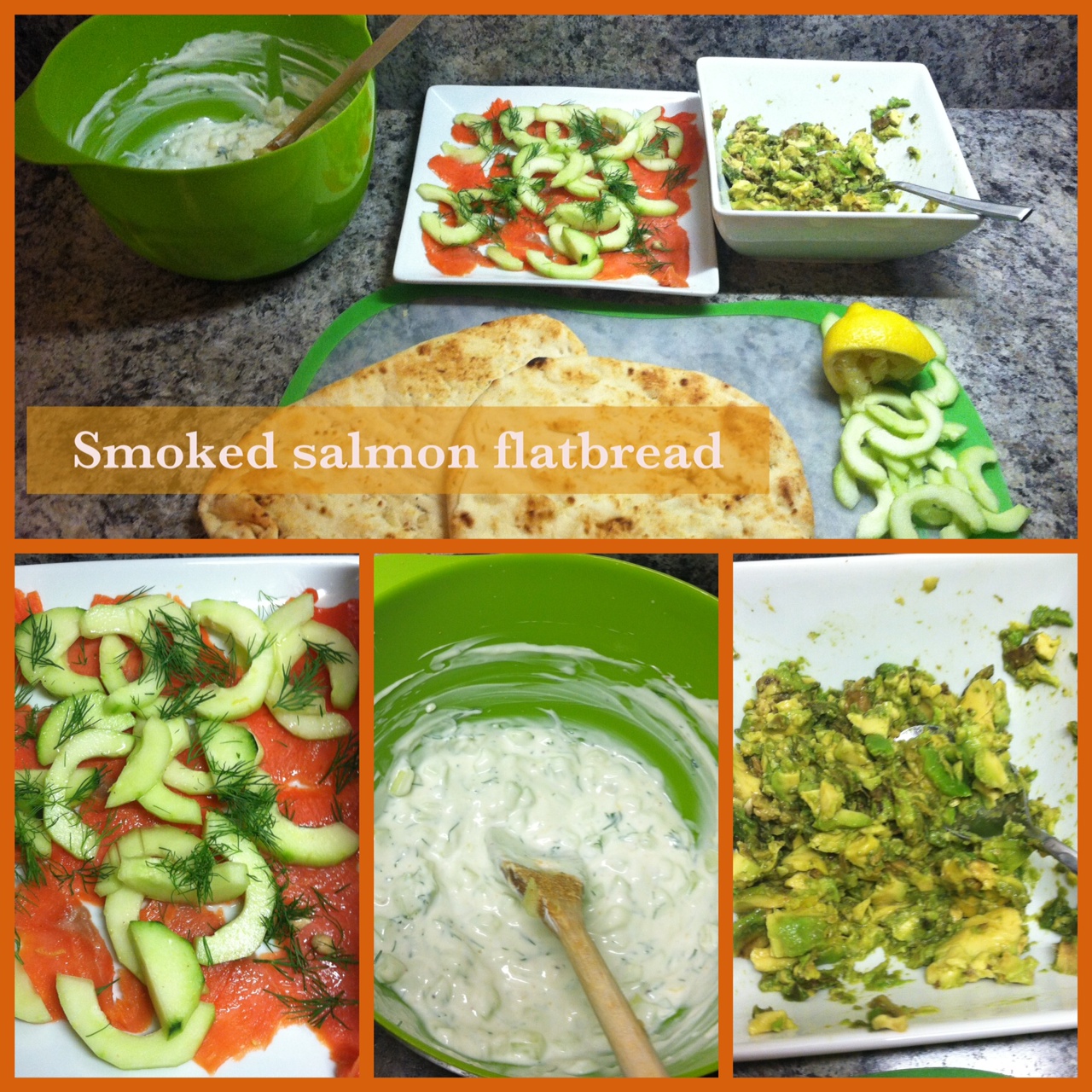
But I refused to be defeated. When Jeremy came back I decided to reinvent this dish into dinner and I knew exactly how to solve the problem. The answer was in the yogurt and the lemon all along. Instead of making crepes, I opted for two big pieces of naan. Then I made a tzatziki sauce with greek yogurt, cucumbers, lemon zest and juice, garlic, salt, pepper and dill. I toasted the naan, rubbed in some olive oil, covered with a layer of tzatziki, then topped that with a mashed avocado mixed with salt, pepper and a squirt of lemon juice. Then I quick “cured” the salmon by laying it flat on a plate topped with cucumbers and dill, then squeezed an entire lemon over top of it all and let it sit while I put the salad together. Then I put the salmon, cucumbers and dill on top of the avocado and voila – perfection.

The problem with the first dish was the similarity of textures and, to a degree, taste. This dish solves that problem by adding in the crunch of the cucumbers, the tanginess of the yogurt and the bright, fresh flavor that the lemon gives to everything.

Redemption: it’s what’s for dinner.

So the lesson is: if at first your recipe is gross, try try again. Seriously. Every chef or cook who has ever invented a recipe has taken it through various tests and many of those tests are bound to fail. You can’t get it right the first time, every time. Although sometimes you do, and it’s amazing, but those times are rare.

Do you have a unique recipe that you created? If so, share it with me! Post it in a comment and maybe I’ll give it a try on the blog! 

BERKFERST NOT MAH FAVRIT MERLS

If you need context for that title, check this out.

Breakfast is hard. Mostly because I don’t get hungry until about 11, but they tell you you’re supposed to eat within 30 minutes of waking up to boost your metabolism. I’ll be perfectly honest here and say that sometimes 11 and “within 30 minutes of waking up” are not always that far apart….but that aside, sometimes I just want a cup of coffee and for everything else to somehow make itself. Also, since I don’t really care for breakfast (on the weekdays – weekends are another story full of bacon and cheesy scrambled eggs and toast with strawberry jam), I try to make it as healthy as possible since my taste buds haven’t always totally woken up.

Last week I had gotten a few local peaches from my co-op and when I got up that morning, somehow all the cereal, bread, jam, and milk had magically disappeared. So I opted for oatmeal with peaches. I told you when I started this blog, there would be some major fails. This one wasn’t major, but it was a misstep – the directions on the oatmeal said to add a 1/4 tsp of salt to the oats while they were cooking. I cut the recipe in half, since it was just me and just threw in a “dash” of salt. Well, either these instructions are bobo to begin with, or my brain is so dysfunctional in the morning that my “dash” was actually a giant pour and this was the saltiest oatmeal I’ve ever had in my life. I tried to add some cream and honey to it to tone it down, but to no real avail. I ended up just mostly eating the peaches with a little bit of the oats. My advice: just don’t put salt in oatmeal. Seriously, whose idea was that anyways?

In any case, I think it turned out “pretty” which is sometimes all I can ask of my food:

BERKFERST

Local honey and peaches with rolled oats

So despite the salt-lick fiasco, let’s talk about the benefits of this meal while pretending it didn’t taste gross. First off, oats are a whole grain, and rolled oats are a less processed version of a whole grain. I’d like to say I can stomach steel cut, as-little-processing-as-possible oats, but I can’t. They’re just gross and should be reserved for horses. Thick rolled oats are my in-between healthy option. I get this brand from the organic/natural aisle of the grocery store. They take 10-20 minutes to cook. Word to the wise – if your “whole grains” take less than 5 minutes to cook, they aren’t really doing you any good. Whole grains are good for your heart, cholesterol, blood pressure (reducing the likelihood of having blood clots, stroke and heart attack), and provide you with folic acid, fiber, b vitamins, iron and more. You can find out more about the benefits of whole grains on the whole grain council website.

Honey is full of antioxidants, is a great way of sweetening food without giving you a sugar rush because of its quick glucose and slow fructose release and if you suffer from seasonal outdoor allergies, locally produced honey can help curb some of those issues because it gives you a healthy, low-dose of the pollen you are allergic to, sort of like a vaccine or an allergy shot would. Find more fun honey info here.
Locally produced honey is the best kind to get (of course) because it will provide your system with the local allergens and pollen, because it helps keep your local honey bee population thriving (which is incredibly important for agriculture overall) and because it taste better because it has to go through less processing. I buy mine from Bee’s Knee’s apiary here in Chesapeake, VA.

Finally, peaches. Ah, peaches. The epitome of July. The highlight of summer. Who would even care if they had health benefits or not, they are so good? But, luckily, they are full of potassium (low potassium is the source of MANY health issues including hypertension, fatigue, muscle weakness and more), beta-carotene (which your body turns in to Vitamin A), lycopene and lutein. They are also high in fiber and vitamin C. It’s important to note that while almost all vegetables and many fruits are “high in fiber” – the fiber usually resides in the skin of the product. Some fiber is contained in the flesh, but when it comes to things like peaches, cucumbers, apples, etc – if you are peeling them before eating them, you are losing out on a lot of fiber and nutrients. Whole food is the best food.

Alright, that’s enough for today’s nutrition lesson. Just remember – skip the salt, use a minimally processed whole grain, leave your fruit’s skin on and skip the sugar and replace it with locally produced honey. And coffee….don’t forget the coffee…..